
Empower Teachers with AI

Built for Education. Driven by real data.
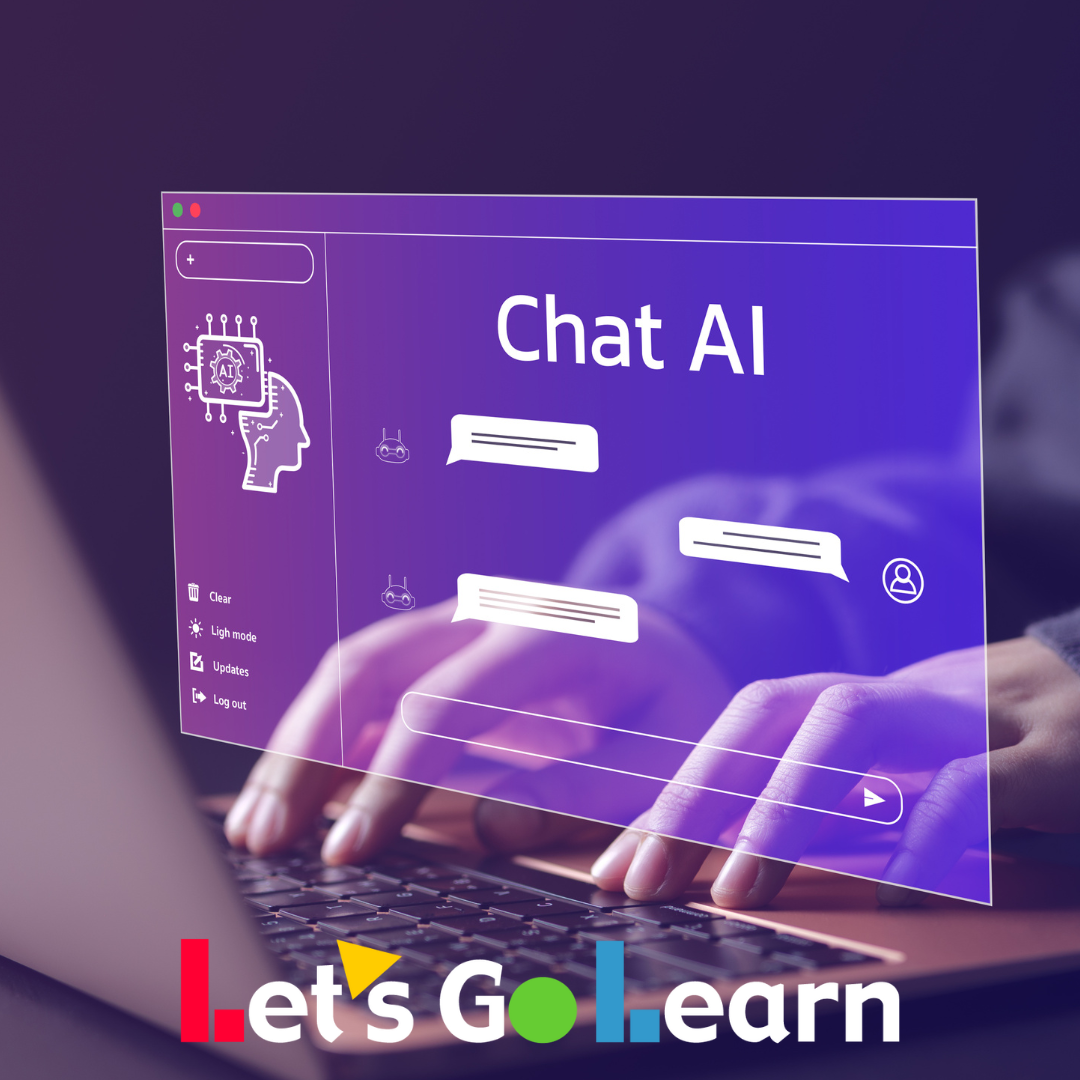
What Is AI in Special Education?

AI Assistants

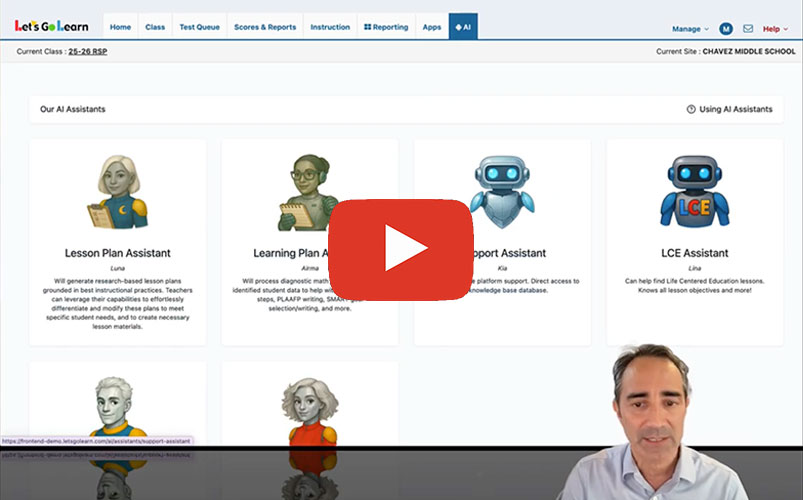
In this quick demo, watch how our AI assistant, Airma, instantly generates a PLAAFP and a SMART goal — right inside the Let’s Go Learn platform. Perfect for IEPs, faster documentation, and more personalized support for students. Let’s Go Learn’s AI Assistants leverage our high-quality data to dramatically save time while improving accuracy and compliance.

  • Built for teachers and specialists
  • Saves time on data evaluation and paperwork
  • Hallucination-free
  • FERPA-compliant

Meet Luna, the Lesson Plan Assistant

See how Luna helps teachers analyze student lessons, identify learning gaps, and provide personalized next steps — all in real time. Whether you’re a classroom teacher, intervention specialist, or administrator, Luna supports you with actionable insights instantly.

  • No extra cost – Luna is available to all Let’s Go Learn users
  • Generate AI-empowered lesson plans for students based on their data
  • Save time and support every learner more effectively

Let Luna do the heavy lifting so you can focus on what matters most — teaching!

Luna will generate research-based lesson plans grounded in best instructional practices. Teachers can leverage their capabilities to effortlessly differentiate and modify these plans to meet specific student needs, and to create necessary lesson materials.

Explore...

AI vs. Humans: Who Writes Better IEPs

Richard Capone interviews Dr. Lynn Ryan, a professor at Providence College, about her research on the use of AI in developing Individualized Education Programs (IEPs).
Explore...

Key Benefits for Special Education

Common Questions

Can AI really diagnose students by listening to them read aloud?

That is a great question. And honestly, we don't think this is the right approach. We know that some students may be able to read but are non-verbal or cannot real aloud fluently. Therefore, these students would be misdiagnosed. Therefore using a single measure like an oral reading AI, can only be a "screener." Our DORA assessment is a multiple measured fully valid and reliable diagnostic assessment. I would rather use a tool like DORA. Just because an AI is new, we don't want to throw out best practices and valid and reliable tools in lieu of a screener that will not be valid diagnostically at times. Now, if you are at a learning facility where you have a huge influx of students and you don't have certified teachers, then hypothetically an AI screener that could listen to students quickly might be useful. But in general, we think it is bad practice to adopt a tool that we know will fail especially with at-risk students or with students with IEPs.

How does Let's Go Learn compare to Journify Learning which is a new AI company in the special education space?

They expect the teacher to have present level data, documents on the students, other testing data and then they will help organize and process this data for the teacher. They do more too. But simply put, we start earlier in the process which is much harder. We provide automated present level diagnostics on each student in reading and math, and from this data we can write present level statements, SMART goals, and more. We also provided an integrated progress monitoring system so we can provide ongoing growth or lack of growth measurement which is a requirement of the IEP process. Check out this Q&A video where we talk about how we compare and visual show how the special education process can be viewed. https://youtu.be/LMNCfVS984E

How do you ensure student privacy with your AI tools?

We act as the firewall between teachers and AI. All teachers in our system are anonymous to the AI GPT that we use. Student data is de-identified. Only the first name of the student is sent over. This means teachers can freely use our system with the AI GPT having no idea who in the world is actually interacting with it. We store past conversations in our own databases. And of course our own data privacy is ensured by the DPA we hold with the school or district or bound by our terms of use agreement.

Why is your system better or different than services like Magic School AI or Amira Learning?

Magic School and programs like it are basically prompt-based AI services that require the teacher to input good information in order for it to help you. Yes, this is a great service. We can do this too when we allow teachers to save prompts in our system. But our real power is in that we provide context engineering which is the next evolutionary step above prompt engineering. When teachers start an AI conversation with us, we pass the student's present level diagnostic data into the AI GPT. So now the AI know exactly what skills the student has mastered within the scope and sequence of all the sub-tests of reading and foundational math. The old adage of garbage in and garbage out is true. If you feed AI grade-level standards or benchmark data, you will get garbage out since this level of data only tells you what the student does not know. It doesn't identify the present level of the student. This is why in special education it is legally required for teachers to identify each student's present levels in their IEP. We do this! Amira Learning on the other hand is trying to assess a student based on oral reading. If you ask any reading specialist, they will tell you that you can't assess kids just based on oral reading fluency. Some kids literally cannot read aloud but are great readers. So the problem is that this is trying to forget what best-practices has told us about learning to read. You need multiple measures. Yes, Amira Learning may be a great tool but don't forget its limits. We are a diagnostic assessment first designed around how a reading specialist would assess a student in reading and a math specialist would diagnose math. Then we provide data and work with the teacher. I think all of the tools mentioned have their places.

How does Let's Go Learn compare to Soapbox by i-Ready?

First, I don't think this product is out as of August 2025. But from what we understand, it is a voice recognition powered fluency test. So students read a passage aloud and then the AI system scores the fluency test. Today, we have a paper-based fluency test as a part of DORA. That is the only measure that is manual with the rest of our system being fully automated in our diagnostic assessment. But we have plans in this area as well! Stay tuned!

Can you really write SMART goals with your AI tool?

Yes, we can. Writing SMART goals is really about storing the district's format rules first. Exactly what type of format do they require. We can store this either in the user-saved prompts or we can create a custom GPT for customers via our Open AI API interface. We can duplicate one of our pre-existing AI assistants like Airma (AI reading math assistant) then we add extra system instructions in its core definition. This makes it natively tuned to the school or district in question. Next, we get better results because SMART goals require knowing the student's present level and where you want to go. We use our diagnostic data to help the teacher set goals and short-term objectives to reach the student's goal. This is key. One big complaint we hear about one of the largest smart goal library systems is that teachers tend to use goals that are disconnected from the student's present levels. It may sound great but it is totally off base.

How does LGL work with students who need accommodations?

Given the nature of Let’s Go Learn assessments, test accommodations will tend to have more flexibility based on the discretion of the resource teacher or the district policy. DORA, ADAM, and DOMA are diagnostic assessments, meaning that their data is generally not used for high-stakes accountability. As a result, if the student’s accommodation calls for the allowance of a calculator during a math assessment, Let’s Go Learn permits this accommodation to be made and does not have any strict policy against a teacher or administrator making this decision. Scores are not rolled up into a normalizing algorithm, which in the case of a high-stakes assessment might restrict scores with accommodations from being used.

How does Let's Go Learn handle progress monitoring and updates? Isn’t that a big pain point in SPED?

Yes — and we built our system around it. Every quiz, assignment, or follow-up assessment given within Let’s Go Learn overlays directly onto a student’s baseline diagnostic profile. That regenerates new scores, growth trends, and updated insights in real time. Because AI always works from fresh, validated data, goal suggestions, lessons, and recommendations remain current and defensible.

MagicSchool and Playground let teachers write everything — why do you insist on diagnostic input?

Those platforms rely heavily on what a teacher types in, which introduces variance, bias, and “hallucination risk.” We differ by starting with precision diagnostic data in reading and math — the hardest parts of SPED already solved. Our AI works with that data instead of replacing it. That means better drafts, more consistency, and less guesswork.

Can I use the AI tool even if I don’t have diagnostic data yet?

Yes, but you’ll get the maximum value when diagnostic data is in the system. You can always input basic information manually if needed, but the quality and reliability of AI-generated drafts scale dramatically when grounded in validated assessment context. Over time, as your students complete diagnostics or quizzes, the system will increasingly drive itself with data.

Do you support goal alignment to state standards or district formats?

Absolutely. We allow districts (or schools) to configure goal templates, formatting rules, and standard alignment. Our AI assistants are tuned to respect local formats, and we can create custom GPTs or prompts to match your district’s style — while still anchoring every output in student data.

How do you guard against AI “hallucinations” or off-track goals?

We use what we call Context Engineering and Guardrails. Because diagnostic data anchors the prompts, the AI is constrained by real performance metrics and growth models. We also surface explainability (why a goal was suggested) so teachers can review, edit, and approve every draft. That reduces errors and improves trust.

Is this tool only for writing IEPs, or does it help with SPED caseload management?

While our primary focus is diagnostic-driven drafting and robust workflows, our architecture supports expanding features like caseload dashboards, usage analytics, and integration with other SPED systems. As we evolve, features such as snapshots, scheduling, or service load tracking may become even more polished — all tied into the same secure, teacher-centric system.

What if my district already has an IEP system (SIS, SPED management software)?

No problem. We design for interoperability. Our system can sync or export data, respect your existing SPED software workflows, and feed AI-drafted content into your district’s systems. You don’t have to commit to a full replacement — you can incrementally adopt our diagnostic + AI layer.

How does Let's Go Learn prove the quality of your AI drafts?

We validate them using expert review and empirical testing. We pilot with SPED professionals who compare AI drafts against their own drafts, and adjust models accordingly. Also, because our inputs are grounded in high-fidelity diagnostic data, the output has a stronger foundation than generic AI systems. We also use a higher priced AI reasoning model for interaction where the teacher is writing PLAAPFs or SMART goals. A lot of AI companies use a non-reasoning model that is faster and good with language but cannot “think” or reason as well.

What AI GPT do you all use?

We currently use Open AI’s Chat GPT. We use a developers version where we can control the model and how it reasons and interacts with you via our learning management system. When your teachers log into our servers, your district technically never interacts with AI. We interact on our backend anonymously for you. In addition, for our more advanced AI assistant, Airma, who helps with IEP writing using diagnostic data fed to her, we use one of the most expensive AI reasoning models. We don’t use the “mini” models that may write well but will hallucinate more often. This cost currently as of September 2025 is on average $2/$8 per million input/output tokens versus $0.40/$1.60 for the mini model that many other companies use. Our philosophy here is that Special Education is a high-compliance educational segment. We deal in precision data thus we must ensure high-quality from start to finish.

What AI GPT LLM do you all use?

Let's Go Learn currently use Open AI’s Chat GPT. We use a developers version where we can control the model and how it reasons and interacts with you via our learning management system. When your teachers log into our servers, your district technically never interacts with AI. We interact on our backend anonymously for you. In addition, for our more advanced AI assistant, Airma, who helps with IEP writing using diagnostic data fed to her, we use one of the most expensive AI reasoning models. We don’t use the “mini” models that may write well but will hallucinate more often. This cost currently as of September 2025 is on average $2/$8 per million input/output tokens versus $0.40/$1.60 for the mini model that many other companies use. Our philosophy here is that Special Education is a high-compliance educational segment. We deal in precision data thus we must ensure high-quality from start to finish.


Diagnostic 

Assessments


Personalized 

Instruction


Discover Additional 

Areas of Focus