

Launching DORA and ADAM: Best Practices for Stress-Free Baseline Testing for Special Education
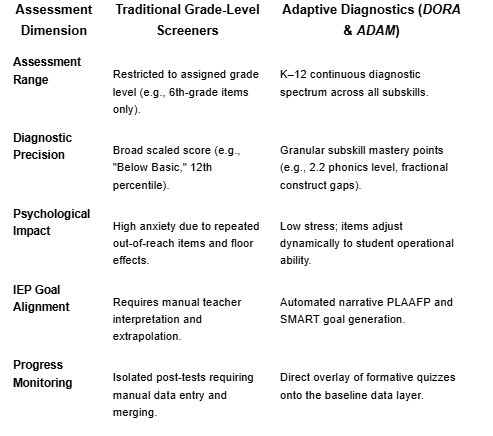
Establishing precise academic baselines within the initial 30 days of the academic year is a critical mandate for special education programs. Traditional screening tools often fail students receiving special education services because they rely on fixed grade-level benchmarks that introduce severe floor effects. When a student working several years below grade level is evaluated with a grade-level screener, the resulting data indicates only that the student is performing below expectations, failing to isolate the specific foundational skill deficits necessary for targeted intervention.

To solve this operational and pedagogical challenge, modern special education frameworks leverage Let’s Go Learn’s CASE-endorsed Diagnostic Online Reading Assessment (DORA) and Adaptive Diagnostic Assessment of Mathematics (ADAM). These computer-adaptive, multiple-measure diagnostic instruments evaluate student capabilities across a K–12 continuum regardless of enrolled grade level, offering a stress-free experience for students while equipping educators with actionable baseline data for Individualized Education Program (IEP) development and progress monitoring.
Architectural Foundation of Adaptive Diagnostics in Special Education
The architecture of DORA and ADAM relies on dynamic computer-adaptive logic designed to determine a student’s precise Zone of Proximal Development (ZPD) without inducing assessment-related anxiety. Unlike static standardized testing, which presents a predetermined set of items tied strictly to grade-level standards, adaptive diagnostics adjust question difficulty in real time based on student response patterns.
If a student demonstrates mastery of a skill, the algorithm escalates to more complex constructs; if a student struggles, the system routes backward along a pedagogical scope and sequence to identify the exact point where mastery breaks down.
Diagnostic Scope of DORA and ADAM
Fully aligned with the Science of Reading, DORA evaluates reading profiles by decomposing reading ability into distinct, highly actionable sub-tests rather than reducing performance to a single composite score. This granular decomposition allows special educators to pinpoint whether a reading comprehension deficit stems from decoding failures, limited oral vocabulary, or weak phonemic awareness.
Similarly, ADAM evaluates mathematical understanding across 44 discrete constructs aligned with the National Council of Teachers of Mathematics (NCTM) strands and state standards.
By assessing these domains independently across a vertical learning trajectory, DORA and ADAM eliminate both floor and ceiling effects. A ninth-grade student reading at a second-grade level is not forced through ninth-grade comprehension passages; instead, the assessment seamlessly pivots to evaluate phonics and word recognition at the second-grade level, preserving the student’s self-efficacy while generating precise diagnostic data.
Let’s Go Learn also offers 2 specialized math assessments that look specifically at pre-algebra and algebra knowledge. DOMA (Diagnostic Online Math Assessment) Pre-Algebra intelligently assesses individual students in 14 Pre-Algebra constructs, while DOMA Algebra looks at 11 algebra constructs. Once completed, both assessments provide teachers with a detailed roadmap for remediation/instruction.
Automatic, personalized learning
Operationalizing the First 30 Days: A Strategic Implementation Roadmap
Launching baseline testing effectively in a special education environment requires a structured operational plan during the first 30 days of the school year. The goal is to establish valid Present Levels of Academic Achievement and Functional Performance (PLAAFP) while minimizing disruption to instructional routines and preventing student over-testing.
Universal Dataset Alignment and Technical Setup
A foundational best practice for launching DORA and ADAM is maintaining a single vertically aligned dataset across general education tiers, Multi-Tiered System of Supports (MTSS), and special education programs. When districts utilize disparate testing tools across tiers, transferring a student into special education results in data loss, requiring re-testing and creating administrative friction. Utilizing DORA and ADAM universally ensures that when a student is referred for special education, historical baseline data is already populated, providing immediate visibility into skill acquisition velocity over time.
During initial configuration, special educators must make sure that built-in Universal Accessibility Features are enabled. DORA and ADAM feature adaptive testing engines that accommodate diverse learning styles through audio-supported questions, visual prompts, and touch-screen compatibility. Because these diagnostics are non-high-stakes and criterion-referenced, teachers possess broad flexibility to schedule breaks, chunk sub-tests over multiple sessions, or adjust testing environments without compromising data validity.
Stress-Free Baseline Testing Administration
The psychological environment in which baseline testing occurs directly influences data accuracy. Students with special needs frequently experience academic frustration when confronted with traditional assessments. To execute a stress-free launch, special educators should adopt specific operational strategies:
- Sub-Test Chunking: Rather than administering all of DORA or ADAM in a single long session, educators should break testing into discrete 15- to 20-minute windows. DORA’s structure allows individual sub-tests (such as Phonics or Oral Vocabulary) to be delivered independently, preserving student focus and stamina.
- Framing as Diagnostic Discovery: Teachers should frame the testing experience not as an evaluation where students can “fail” but as an adaptive discovery tool designed to help teachers build personalized learning paths.
- Audio and Accessibility Supports: For reading sub-tests evaluating comprehension rather than decoding, or for mathematics sub-tests in ADAM, audio read-aloud functionality should be leveraged to ensure that reading deficits do not skew diagnostic clarity or artificially depress scores.
Automated IEP Integration and PLAAFP Development
Once baseline testing is complete, the platform’s narrative translation engine processes raw sub-test results and translates them directly into narrative PLAAFP descriptions, grade-level equivalencies, and skill-mastery profiles. This transition from raw assessment output to narrative present-level statements represents a significant structural efficiency for special education case managers.
Traditional IEP development requires teachers to manually collate scores from multiple instruments, extrapolate baseline performance, and write narrative descriptions from scratch. DORA and ADAM automate this process by outputting narrative PLAAFP text that explicitly states what a student knows and where skill gaps originate. For instance, instead of stating that a seventh-grade student “struggles with math,” the ADAM narrative report may specify that the student has mastered multi-digit addition but exhibits specific gaps in fractional concepts at a 3.5 grade level.
Specially Designed Instruction Activation and Continuous Progress Monitoring
The final phase of the 30-day launch involves connecting baseline data directly to Specially Designed Instruction (SDI) and progress monitoring. Following assessment, the Let’s Go Learn platform automatically constructs a gap-driven instructional path via LGL Edge. This automated SDI targets the exact skill gaps identified during baseline testing, ensuring that every instructional minute is spent within the student’s Zone of Proximal Development.
To maintain legal and substantive compliance under the Individuals with Disabilities Education Act (IDEA), progress monitoring must occur continuously rather than periodically. DORA and ADAM fulfill this requirement through a turnkey overlay mechanism. When teachers assign short standards-aligned formative quizzes on a weekly, monthly, or quarterly schedule, the quiz results automatically overlay onto the original baseline diagnostic data layer. The platform recalculates total subskill mastery scores without requiring the student to retake the full diagnostic assessment.
Stress Reduction Framework for the Special Education Ecosystem
Reducing stress during baseline testing is a multi-dimensional requirement that encompasses the psychological safety of the student, the administrative workload of the educator, and the regulatory compliance obligations of district leaders.
Psychological Safety and Cognitive Load Reduction for Students
Special education students frequently experience heightened test anxiety due to chronic academic struggle. Traditional grade-level assessments exacerbate this stress by repeatedly presenting items far beyond the student’s functional level, reinforcing feelings of helplessness. DORA and ADAM mitigate cognitive load and emotional distress through adaptive calibrated item delivery, which balances success and challenge to maintain engagement.
Additionally, during test sessions, visual indicators of grade levels are decontextualized. A secondary student taking a primary-level phonics sub-test interacts with age-appropriate interfaces without demotivating labels indicating lower-grade content. Following assessment, students transition into LGL Edge, where instruction utilizes gamified elements, songs, and interactive feedback. When errors occur, the platform provides immediate instructional coaching rather than simple right-or-wrong notifications, fostering academic resilience.
Educator Workload Mitigation and Burnout Prevention
Special education teacher attrition is heavily driven by administrative paperwork, particularly the time-consuming process of compiling assessment data, drafting IEP present levels, and manually recording progress-monitoring metrics. DORA and ADAM directly relieve administrative burden through comprehensive workflow automation.
Diagnostic data automation alone reduces the time required to write an IEP by approximately 50%, as teachers no longer need to perform manual data integration or statistical analysis. Furthermore, turnkey progress monitoring eliminates manual record-keeping spreadsheets. Because formative quizzes automatically update the baseline dataset, educators generate compliance-ready growth charts with a single click. Vertical data continuity also ensures that when students move between schools or tiers, their complete diagnostic history transfers automatically, eliminating intake diagnostic re-testing.
Next-Generation IEP Workflows: Contextual AI Integration and Substantive Compliance
A major advancement in operationalizing baseline testing is the integration of contextual Artificial Intelligence (AI) designed specifically for special education workflows. Let’s Go Learn incorporates an AI writing assistant, known as Airma, which sits directly on top of the diagnostic data layer.
Online tools for special education
Context Engineering versus Generic AI Prompting
Generic large language models often produce superficial or legally risky IEP drafts because they lack direct grounding in validated student data, requiring teachers to write complex prompts and manually enter sensitive student information. Airma overcomes these limitations through Context Engineering. Instead of relying on manual user prompts, the system automatically feeds validated, granular results from DORA and ADAM directly into secure AI reasoning models.
Airma extracts specific skill deficits, grade-level equivalencies, and ZPD bounds from the baseline test to instantly draft comprehensive PLAAFP statements, measurable annual SMART goals, short-term objectives, and recommended instructional accommodations. When Airma is deployed alongside DORA and ADAM diagnostics, teacher time savings on IEP administration increase from 50% to 85%, allowing special educators to reallocate hundreds of hours toward direct instruction.
Security, FERPA Compliance, and the AI Firewall
To comply with the Family Educational Rights and Privacy Act (FERPA) and the Individuals with Disabilities Education Act (IDEA), the platform incorporates a specialized AI Firewall. Before any diagnostic data is processed by generative AI models, the AI Firewall automatically strips all Personally Identifiable Information (PII), such as student names, state IDs, school names, and birthdates.
The AI model operates exclusively on anonymized numerical scores and skill constructs. Once the draft text is generated, it re-populates into the teacher’s secure cloud-based document workspace, where the educator maintains full authority to review, edit, approve, or reject any AI-generated recommendations.
Strategic Recommendations for District Leaders
To successfully operationalize DORA and ADAM for stress-free baseline testing across a school district or special education program, administrative leadership should establish clear operational protocols:
- Mandate Vertically Aligned Assessment Tools: Standardize diagnostic testing across Tier 1 general education, MTSS interventions, and Tier 3 special education to ensure seamless data transfer, shared pedagogical language, and immediate baseline availability upon SPED identification.
- Establish Clear 30-Day Testing Windows: Structure administrative schedules so that diagnostic baseline testing occurs within the first 30 days of school, encouraging schools to chunk testing into short 15- to 20-minute sessions to preserve student energy and optimize data integrity.
- Leverage Turnkey Progress Monitoring for Compliance: Require special educators to utilize built-in formative quiz overlay features rather than external progress-monitoring tools, guaranteeing continuous data collection while ensuring legal IDEA compliance.
- Provide Targeted Professional Development: Deliver professional development frameworks that train teachers on data-driven goal writing, ZPD identification, and the ethical use of grounded AI tools like Airma.
- Focus on Acceleration over Remediation: Ensure that post-assessment instruction prioritizes filling foundational gaps to accelerate students toward grade-level standards, rather than keeping students trapped in low-level, isolated remediation paths.
By uniting computer-adaptive diagnostics, automated progress monitoring, and secure AI workflows, educational leaders can transform special education baseline testing from a stressful administrative hurdle into a streamlined, highly effective launchpad for student achievement.
