

Operationalizing DORA and ADAM: Best Practices for Stress-Free Baseline Testing in the First 30 Days
Architectural Overview of DORA and ADAM Adaptive Diagnostics
Establishing accurate academic baselines within the first 30 days of the school year requires diagnostic tools capable of measuring student capability without introducing floor or ceiling effects. Traditional universal screeners and computer-adaptive benchmark assessments frequently rely on brief, timed probes or predictive algorithms. While these tools can flag a student as performing below grade-level expectations, they routinely fail to isolate the specific underlying skill gaps responsible for the deficit. Consequently, educators are often left with aggregate scaled scores that indicate a need for intervention but offer no actionable guidance on where instruction should begin.
The Diagnostic Online Reading Assessment (DORA) and the Adaptive Diagnostic Assessment of Mathematics (ADAM) address this limitation through non-predictive, criterion-referenced adaptive engines. Rather than estimating performance based on sample test items or restricting items to a student’s enrolled grade level, these engines evaluate mastery across granular scope-and-sequenced constructs.

The diagnostic workflow begins at the adaptive engine level, where student responses directly determine item selection across vertically aligned K–12 skill continua. Raw performance data then flows into automated data filters, where behavioral telemetry—specifically Reading Time and Question Response Time—is evaluated to verify student engagement. Validated datasets populate class-level diagnostic profiles and strand analyses, which immediately route into two parallel instructional frameworks: general education Multi-Tiered System of Supports (MTSS) pathways, such as core scaffolding and Zone of Proximal Development (ZPD) intervention, and special education compliance frameworks, such as Present Levels of Academic Achievement and Functional Performance (PLAAFP) generation and automated Specially Designed Instruction (SDI).
DORA systematically measures K–12 reading capability across seven foundational sub-tests: Phonological Awareness, Phonics, High-Frequency Words, Word Recognition, Oral Vocabulary, Spelling, and Reading Comprehension (Informational Text), alongside Reading Automaticity. The adaptive algorithm dynamically navigates this learning continuum. If a student exhibits significant decoding deficits, the assessment automatically adjusts the starting level for silent reading comprehension passages. This prevents student frustration while maintaining measurement accuracy across isolated subskills.
ADAM evaluates mathematical understanding across 44 discrete sub-tests aligned with the five National Council of Teachers of Mathematics (NCTM) content strands: Numbers and Operations, Algebra, Geometry, Measurement, and Data Analysis. Operating across a K–7/8 developmental range, ADAM isolates mastery points and specific learning gaps across all grade-level standards. By evaluating every concept independently, ADAM identifies a student’s precise Zone of Proximal Development without assuming that a gap in one strand implies failure across another.
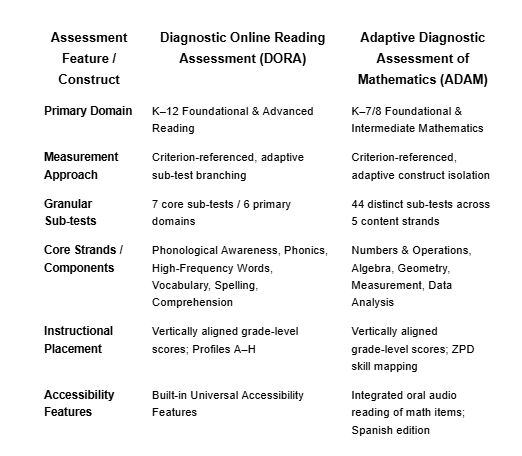
The structural separation of reading capability from mathematical reasoning is a critical feature of ADAM. Standard assessments often confound mathematical evaluation with reading load, penalizing struggling readers who possess strong conceptual math skills. ADAM eliminates this confound by incorporating audio narration for text items, ensuring that the diagnostic output reflects pure mathematical reasoning. Furthermore, both DORA and ADAM include built-in universal accessibility features and native Spanish adaptations, supporting valid baseline evaluations across English Learners and students with diverse learning needs.
Let's Go Learn's diagnostic assessments
With Let’s Go Learn, you can create personalized instruction that inspires success for each learner, as you differentiate curriculum for intervention, remediation, and enrichment.
Strategic Implementation: Week 2 Launch Protocol and Test Administration
Integrating baseline diagnostic testing into the academic calendar requires deliberate timing. Scheduling testing during Week 2 of the first 30 days provides an optimal operational window. Week 1 should remain dedicated to establishing classroom culture, setting behavioral norms, organizing school logistics, and verifying device accessibility. Attempting to test during the first week frequently heightens student anxiety and leads to technical delays, contaminating baseline data. Launching in Week 2 capitalizes on established classroom routines and captures initial academic status before formal core instruction alters baseline entry points.
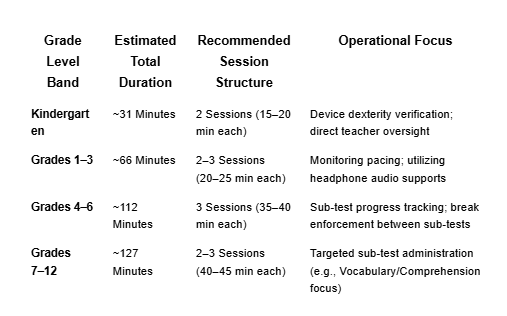
Both DORA and ADAM are untimed assessments designed to eliminate time-pressure anxiety and measure maximum true capacity. However, test delivery must be structured to prevent cognitive fatigue, particularly for younger learners or students receiving intervention. Administration should be broken across multiple short testing windows throughout Week 2 rather than completed in a single session.
Proctoring protocols—whether tests are conducted in person or via synchronous virtual platforms such as Zoom—must maintain structural consistency. Proctors must establish clear audio controls, disable peer-to-peer chat mechanisms, and frame the assessment correctly to students. Educators should explain that adaptive tests are designed to present increasingly difficult items until an individual’s challenge threshold is reached. Reassuring students that unmastered items are an expected component of the diagnostic process helps minimize test anxiety and deters guessing.
Because DORA and ADAM are criterion-referenced diagnostic tools rather than high-stakes accountability measures, testing accommodations can be applied with greater flexibility based on district policies and Individualized Education Program (IEP) specifications. For instance, if a student’s IEP permits calculator usage during general math instruction, allowing a calculator during ADAM does not invalidate the assessment. The engine continues to isolate problem-solving and geometric and algebraic constructs independently of computational stamina.
Data Hygiene and Verification: Filtering Noise for Clean Baseline Scores
The utility of baseline diagnostic data depends on its validity. If a student approaches the assessment with poor effort, rushes through reading passages, or engages in random clicking, the resulting score will reflect behavioral compliance rather than actual academic capacity. Establishing clean data requires systematic data hygiene procedures before instructional planning.
Educators can inspect student engagement and effort telemetry using the CO Detail Report within the Let’s Go Learn platform. This report tracks two core metrics: Reading Time (RT), which measures the cumulative duration a student spends engaging with silent reading passages prior to answering comprehension questions, and Average Question Response Time (QT), which records the average time expended per item across specific sub-tests.
The data verification process enforces a strict audit rule: if students’ Reading Time falls below established passage-reading thresholds or if their Question Response Time averages under three seconds per item, the engine flags the resulting scores as invalid due to random clicking or lack of effort. When these behavioral patterns occur, educators do not need to re-administer the entire battery. Instead, the teacher accesses the platform administrative settings to selectively reset only the compromised sub-test, preserving all previously validated data from completed sub-tests and re-evaluating the student under proctored small-group conditions.
Data synthesis strategies also vary based on grade bands. For secondary students in grades 6 through 12, foundational decoding skills such as high-frequency words, word recognition, and phonics are typically mastered. Baseline data collection for middle and high school cohorts should focus heavily on vocabulary (VO) and comprehension (CO) to pinpoint real areas of academic need.
For secondary writing workshops, incorporating the spelling sub-test alongside vocabulary and comprehension provides a comprehensive baseline. Students who score high in vocabulary and comprehension but low in spelling often avoid using complex vocabulary in written expression due to spelling anxiety. Identifying this pattern allows educators to deliver targeted writing accommodations.
Finally, administrators and department heads can monitor aggregate cohort performance using the Weighted Score (WS) metric on the Scores and Report dashboard. The weighted score calculates a vertically aligned grade-level average score across the class or grade band, providing an accurate benchmark for longitudinal growth tracking across the academic year.
Synthesizing Baseline Data for Instructional Action and MTSS/IEP Integration
Once baseline data has been validated, educators must transition from data collection to instructional activation. The Class Profile Report converts granular diagnostic results into actionable instructional groupings. In reading, the platform categorizes students into distinct instructional profiles, designated as Profiles A through H, based on their specific combinations of decoding, vocabulary, and comprehension masteries.
Raw classroom diagnostic data branches into two main analysis tracks: DORA Class Profiles A through H and ADAM Strand Analyses across 44 sub-test constructs. In general education, these outputs organize students into flexible reading groups and math skill-deficit clusters, which feed directly into automated LGL Edge learning paths tuned to each student’s Zone of Proximal Development. In special education, these diagnostic points provide validated PLAAFP statements, which feed into context-engineered AI frameworks to automate compliant IEP drafting and Specially Designed Instruction.
Instead of relying on broad grade-level categories, these profiles allow teachers to establish targeted flexible groups immediately:
- Profiles A and B (High Decoding, High/Low Vocabulary, High Comprehension): Students possess solid foundational mechanics and require advanced comprehension acceleration or targeted vocabulary enrichment.
- Profiles C and D (High Decoding, Low Vocabulary, Low Comprehension): Students exhibit fluently automated decoding mechanics but struggle with language acquisition or conceptual knowledge, requiring explicit vocabulary and passage-structure instruction.
- Profiles E and F (Low Decoding, Variable Vocabulary, Low Comprehension): Students encounter severe text-access barriers due to decoding deficits, requiring systematic, explicit phonics and word-attack interventions.
These baseline profiles link directly to automated instruction within LGL Edge and LGL Math Edge. The platform uses diagnostic performance data to build individualized learning paths within each student’s Zone of Proximal Development. This ensures that supplemental activities automatically target prerequisite skill gaps without repeating already mastered content.
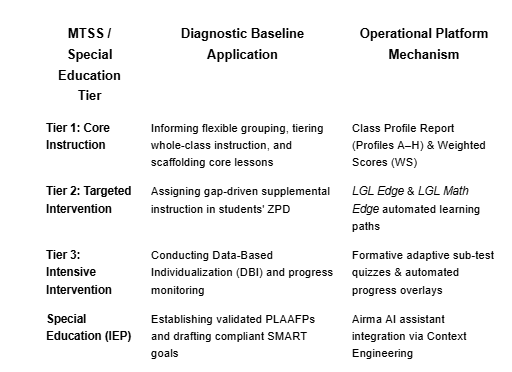
For Special Education directors and resource teachers, baseline diagnostic data simplifies IEP development and legal compliance. ADAM‘s 44 sub-tests and DORA’s 7 sub-tests provide validated Present Levels of Academic Achievement and Functional Performance statements. By identifying the highest skill mastered and selecting the next incremental construct in the scope and sequence, educators can construct objective, measurable SMART goals.
This process is further streamlined through AI integration via tools like Airma. Using Context Engineering, the platform securely transfers de-identified student present-level data through FERPA-compliant firewalls. Airma synthesizes baseline data to generate initial drafts of PLAAFP statements, Specially Designed Instruction recommendations, and aligned SMART goals.
This workflow reduces administrative IEP drafting time by 50% to 85% while improving goal consistency and legal defensibility. As students complete follow-up formative quizzes throughout the year, updated scores overlay the baseline dataset. This provides continuous progress monitoring data for IEP meetings and parent reporting without requiring re-testing.
Online tools for special education
Strategic Implementation Roadmap
Administering adaptive baseline assessments within the first 30 days creates a foundation for data-driven instruction throughout the academic year. The shift from brief predictive screeners to granular diagnostic models gives school districts immediate clarity regarding student learning needs. Executing a successful, stress-free baseline testing initiative relies on four distinct operational phases executed across the first month of school:
- Phase 1: Launch Preparation (Week 1): Focus on establishing classroom culture, verifying student device readiness, configuring accessibility accommodations, and framing the adaptive nature of DORA and ADAM to students to set expectations and lower test anxiety.
- Phase 2: Adaptive Administration (Week 2): Administer assessments across short, untimed sessions aligned with recommended grade-level durations, enforcing standardized proctoring protocols across both in-person and remote settings.
- Phase 3: Data Hygiene and Verification (Week 3): Review student effort telemetry within the CO Detail Report, evaluating Reading Time and Question Response Time metrics to invalidate and reset specific sub-tests where rapid clicking or low effort compromised score integrity.
- Phase 4: Instructional Activation and Compliance (Week 4): Leverage the Class Profile Report to create flexible reading and math groups, activate automated ZPD learning paths in LGL Edge, and export validated present-level data into Airma to generate compliant IEP documentation and tier 1–3 intervention plans.
Adopting this structured framework transforms baseline testing from a routine administrative requirement into an effective operational strategy. By combining accurate diagnostic assessment, thorough data validation, and targeted instructional alignment, educational leaders ensure that every student is placed on an accelerated path toward academic growth.
