

Re-engineering Special Education Workflows from Diagnostic Data to Contextual AI
Top 3 Key Takeaways
- The primary ethical and operational crisis in special education is not the introduction of artificial intelligence; it is the systemic failure to provide teachers with precision diagnostic data at the foundational level of Individualized Education Program (IEP) development.
- While compliance-focused roles, such as Due Process or IEP coordinators, are essential for district oversight, their implementation in practice can result in weak IEP documentation when initial diagnostic data is not solid.
- True “exponential change” requires a workflow where validated present-level diagnostic data feeds directly into contextual AI, allowing compliance leaders to shift from administrative troubleshooting to high-level instructional oversight.
The Invisible Crisis of the Special Education Workflow
The landscape of special education is currently defined by a profound paradox: while legal requirements for documentation and procedural compliance have never been more stringent, the foundational support provided to the teachers responsible for meeting these requirements has remained remarkably stagnant.

District leaders frequently observe a high rate of burnout among special education staff, often attributed to the “paperwork mountain” associated with the development of Individualized Education Programs (IEPs). However, a deeper analysis reveals that the true burden is not merely the volume of documentation, but the lack of accurate, foundational data required to build those documents with professional confidence.
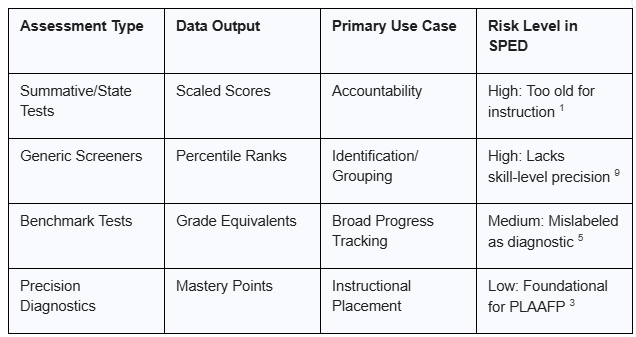
In many school systems, special education teachers are tasked with identifying a student’s present level of academic achievement and functional performance (PLAAFP) using tools that were never designed for this purpose or no tool at all, other than the quizzes or paper tests that they pick and choose on their own. When technology tools are used, teachers are often forced to rely on general education screeners or benchmark assessments that provide a scaled score or a national percentile but fail to pinpoint the specific skill gaps that define a student’s actual current instructional mastery point. For a non-special education audience, it is essential to understand that the “present level” means the student’s actual current instructional mastery point: the level at which the student is really performing right now, not just the grade level in which the student is enrolled.
When a teacher is denied precision diagnostics, the entire IEP becomes a house of cards. Without a valid starting point, the goals drafted are often too broad or misaligned, the accommodations are based on generic assumptions, and the instruction fails to move the needle on student growth. This systemic failure has created a market for “layers of change”: tools designed to mask the underlying data gap by automating the generation of goals or the checking of documents for compliance. While these tools may improve the speed of filing, they do little to improve the quality of education or the efficiency of the teacher’s workflow.
The Impact of Data Quality on IEP Accuracy
The Role of the Compliance Coordinator: Oversight vs. Drafting
To manage the heavy administrative demands of the Individuals with Disabilities Education Act (IDEA), many districts have established specialized roles to bridge the gap between classroom instruction and legal documentation. Across various states, these oversight responsibilities are managed by professionals holding titles such as Due Process Coordinator, IEP Coordinator, Special Education Process Coordinator, or Special Education Compliance Coordinator.
These roles are vital for the integrity of a district’s special education department. They ensure that timelines are met, procedural safeguards are followed, and the language within an IEP is defensible and clear. However, structural friction often occurs when these coordinators are tasked with writing or approving the initial IEP narrative without having a direct, daily instructional relationship with the student. In these cases, the coordinator is forced to rely on “file data” that is frequently general, outdated, or disconnected from the student’s actual performance in the classroom.
If teachers and coordinators were supported by precision diagnostic data from the start, the nature of these roles would change for the better. Instead of spending hours trying to interpret vague screener data to build a compliant but misaligned narrative, the coordinator could focus on true oversight: ensuring that the student’s specially designed instruction (SDI) is being implemented with fidelity and that the IEP is moving the student toward meaningful growth. By fixing the data foundation, districts can preserve a more direct and accurate connection between the classroom teacher’s insight and the legal document that guides the student’s journey.
The Mirage of SMART Goal Libraries
The educational technology industry has responded to the special education crisis by producing a plethora of tools focused on procedural compliance. One prominent example is the widespread adoption of SMART goal libraries, such as Goalbook. These systems provide teachers with a vast repository of pre-written, standards-aligned goals that can easily be inserted into an IEP.
While these libraries are marketed as a way to support teachers, they often create a “mirage” of quality. Administrators frequently find that these libraries lead to goals that sound professional but are functionally disconnected from the student’s actual needs. The fundamental flaw is that these tools, while solidly built, assume the teacher already knows the student’s present levels with precision. When teachers lack that data, they select a goal that “sounds right” for a student’s grade level or disability category, rather than a goal that targets the specific instructional mastery point identified through diagnostic testing.
Comparison of Roles in Document Development
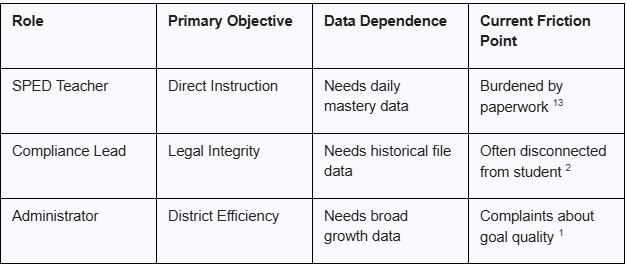
The goal for forward-thinking districts must be a transition from these “layers of change”–adding more coordinators and more goal banks–to “exponential change” by fixing the foundation of the workflow. This means providing every stakeholder in the IEP process with access to the same precision diagnostic data: a single source of truth that defines the student’s instructional mastery point across dozens of skill-level sub-tests in reading and math.
The Diagnostic Gap: Scaled Scores vs. Instructional Mastery
To understand why the current workflow is often inefficient, one must examine the specific type of data that dominates the K-12 market. Most assessment systems used for “personalization” are actually benchmark tests that provide a single score, such as a Lexile level or a Quantile score. While these scores are useful for norm referencing, they are insufficient for instructional placement in special education.
A student who is three years below grade level in math does not need to know their national percentile; they need their teacher and their coordinator to know exactly where their understanding of numbers and operations collapsed. Many assessments mislabeled as “diagnostic” are actually just adaptive screeners that stop as soon as they determine that a student is below grade level. True precision diagnostics, such as Let’s Go Learn’s DORA and ADAM, go deep below grade level to identify specific skill deficits.
The Anatomy of Precision Diagnostics in Reading
In reading, a precision diagnostic must separate the multiple components of literacy to provide a clear picture of the student’s needs. A generic score conflates phonics, vocabulary, and comprehension, which can lead to inappropriate interventions. For instance, a student with a high vocabulary but low comprehension may be mislabeled as a “weak reader” when the true issue is a lack of inferential strategies. Conversely, a student who can decode perfectly but has low vocabulary will struggle to understand any text, regardless of its readability level.
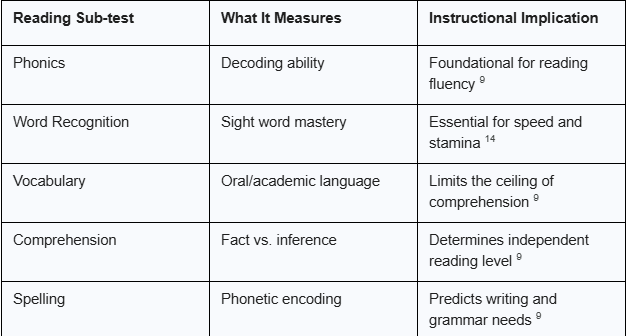
The transition from a “single-score placement” system to a multi-point diagnostic system is transformative. It moves the conversation from “the student is at a 2.5 grade level” to “the student has mastered CVC patterns but struggles with vowel digraphs.” This level of detail is the difference between an IEP that meets the letter of the law and an IEP that actually changes the student’s life.
Contextual AI: The “Good Data In, Good Data Out” Philosophy
As artificial intelligence begins to permeate the EdTech market, we are seeing the same mistakes being repeated: “first-generation” prompt-based AI tools are being marketed as solutions for special education without a foundation of valid data. These tools rely on the teacher to type in descriptions of the student or paste in old reports, then use Large Language Models (LLMs) to generate “draft” IEPs.
This is a dangerous approach. AI is not a trusted diagnostic engine; it is not yet valid and reliable enough to directly diagnose students on its own. Without context, AI will fill in the gaps of a weak description with “compelling but inaccurate fiction.” If a teacher tells an AI that a student “struggles with reading,” the AI might generate a beautiful goal for phonics when the student actually needs help with vocabulary.
Let’s Go Learn takes a fundamentally different position: that AI should assist the teacher by interpreting, drafting, and organizing good data. By feeding the AI precision diagnostic results from DORA and ADAM, we provide the “contextual AI” needed to generate evidence-based PLAAFPs and SMART goals. The AI is not guessing; it is transforming a student’s mastery of specific skills into the required legal and pedagogical formats used by the district.
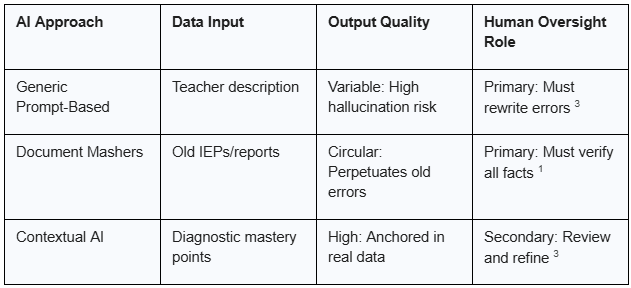
The transition to contextual AI represents an “exponential change” in the special education workflow. It eliminates the hours spent by teachers and coordinators manually analyzing data and searching for the right wording in a goal library. Instead, the system presents a data-driven draft that teachers can then review and modify based on their personal knowledge of the student.
Why Districts Struggle to Change the Workflow
The persistent reliance on weak data and procedural “layers of change” is often a result of inertia. District leaders are under immense pressure to maintain compliance and avoid active parent complaints. In this environment, a tool that promises to “fix compliance” with a library of goals sounds like an easy win. However, goal quality in these systems measurably degrades as caseloads increase.
True change requires a vision for “exponential change”: a complete re-engineering of how data moves from the student’s brain to the IEP. This starts by recognizing that benchmark screeners and summative tests are not diagnostic. It requires admitting that scaled scores alone cannot determine exact instructional starting points. And it requires the courage to empower teachers and coordinators with the same precision-level data.
The Difference Between Incremental and Exponential Change
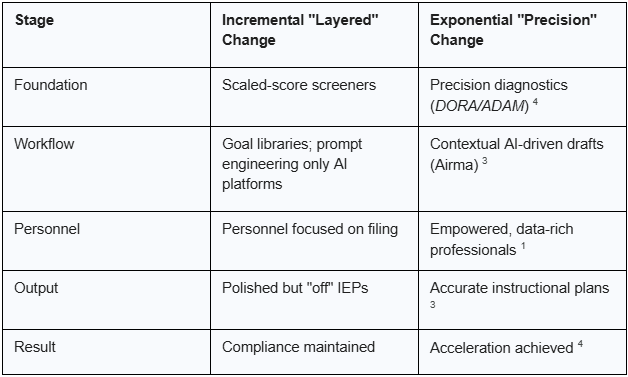
Why It Matters
If the goal is to move the needle on student achievement while reducing the administrative burden on special educators, the roadmap is clear.
- Audit Your Diagnostic Foundation: Determine if your current assessments are truly diagnostic or just screeners mislabeled as such. If you are placing students based on scaled scores or Lexile levels, your personalization is likely weak. If you only give your special education teachers CBM quiz tools or manual testing systems, they will lack the ability to find students’ true present levels efficiently.
- Re-evaluate “Compliance” Tools: Look critically at goal libraries and document checkers. Are they helping teachers understand their students better, or are they just making it easier to file documents that lack instructional precision?
- Bridge the Disconnect: Ensure that your compliance coordinators have access to granular, skill-level diagnostic data. The coordinator should not be guessing at a student’s present level; they should be looking at the same 44-point math mastery profile as the teacher.
- Ground Your AI Strategy: Do not adopt AI tools that rely on generic prompts. Make sure that any AI used for IEP development is grounded in valid, reliable present-level diagnostic data.
- Focus on Acceleration, Not Remediation: Students who are behind must grow at a rate faster than one year per year. This is only possible through accurate starting-point placement and instruction that targets their specific Zone of Proximal Development.
The ethical crisis in special education is not the introduction of AI; it is the continued expectation that teachers can provide individualized support without individualized data. It is time to stop layering more compliance on top of a broken foundation. By starting with precision diagnostics, we can build a special education workflow that is legally defensible, professionally empowering, and instructionally accurate for the students it serves.
Final Thoughts
The path to a compliant, effective special education program does not lie in more paperwork or more centralized coordination; it lies in precision. When we empower the teacher and the coordinator with the student’s actual current instructional mastery point, we eliminate the need for the “copy-paste” culture that currently plagues our field. We turn the IEP from a hurdle into a roadmap. This is the promise of Let’s Go Learn: a system built on the belief that accurate instructional action requires accurate diagnostic data. We are here to help you move beyond the layers of change and achieve the exponential results your students deserve. The Let’s Go Learn special education platform was also just recently adopted as a foundation for the CEC Teacher Empowerment Toolkit, a free tool for the members of the largest network of special education professionals in the world.
Works Cited
-
- AI in IEPs—When the Real Ethical Question is Before the AI – Let’s Go Learn, accessed April 14, 2026, https://www.letsgolearn.com/education-reform/ai-in-ieps-when-the-real-ethical-question-is-before-the-ai/
- Understanding Our AI Leadership – Let’s Go Learn, accessed April 14, 2026, https://www.letsgolearn.com/challenges/understanding-our-ai-leadership/
- LCE 2.0 All Lessons Plans Titles – for Customers to View (1).xlsx
- BLOG_The Hierarchy of Instruction in Math with Let’s Go Learn (2).pdf
- IEP Goal Generator: Write SMART Goals in 2 Minutes – Lernico – AI, accessed April 14, 2026, https://www.lernico.ai/blog/iep-goal-generator
- USING DIGITAL TEACHER INPUT FORMS IN DEVELOPING PRESENT LEVELS OF ACADEMIC ACHIEVEMENT AND FUNCTIONAL PERFORMANCE (PLAAFP) – ERIC, accessed April 14, 2026, https://files.eric.ed.gov/fulltext/ED673749.pdf
- Using DORA for Secondary Reading and Writing Workshops (3).pdf
- Experience with Goalbook? : r/specialed – Reddit, accessed April 14, 2026, https://www.reddit.com/r/specialed/comments/nk8r5r/experience_with_goalbook/
- Top 10 Best Iep Goal Tracking Software of 2026 – WifiTalents, accessed April 14, 2026, https://wifitalents.com/best/iep-goal-tracking-software/
- hingham public schools strategic plan update #3 2022-2023 – AWS, accessed April 14, 2026, https://core-docs.s3.us-east-1.amazonaws.com/documents/asset/uploaded_file/4900/HPS/4491254/Item-6.2-Hingham-Public-Schools-Strategic-Plan-Overview-Update-3.pdf
- Job Descriptions – Fulton Public Schools, accessed April 14, 2026, https://www.fulton58.org/departments/human-resources/job-descriptions
- Generic Parent Letter (DORA, ADAM, DOMA, and Edge) (4).pdf
- Mountain Brook Schools Special Education Program Improves Progress Monitoring, Resulting in Increased Student Outcomes | Innovating Instruction – Medium, accessed April 14, 2026, https://medium.com/innovative-instruction/mountain-brook-schools-special-education-program-improves-progress-monitoring-resulting-in-61e9d717e20f
