

Optimizing District Family Engagement through Diagnostic Assessment and Collaborative Capacity-Building
District-wide family engagement initiatives are increasingly recognized as indispensable drivers of student achievement, reduced chronic absenteeism, and systemic education reform1. Decades of empirical literature confirm that when families are actively engaged in their child’s educational journey, students demonstrate higher standardized test scores, stronger self-confidence, and reduced behavioral disruptions2. For district administrators tasked with leading these initiatives, the core objective is to shift from superficial, transactional notifications toward a deeply collaborative home-school partnership1.
However, many district-level initiatives operate at a structural disadvantage because the assessment data communicated to families lacks practical utility6. When score reports are delivered in abstract, confusing formats, parents are left feeling anxious yet powerless to assist their children6. To resolve this bottleneck, school districts must reform their assessment infrastructures, transitioning from comparative peer-ranking metrics to actionable, diagnostic-prescriptive frameworks7.
The Core Disconnect in Traditional Family Engagement Reporting
A fundamental vulnerability in many district family engagement strategies is the historical reliance on norm-referenced reporting for parent-teacher communications6.

Norm-referenced scores evaluate a student’s performance in relation to a representative peer group, typically reporting progress through standard scores, stanines, or percentile ranks11. The core paradox of these metrics is that they are highly functional for students performing above grade level, as they validate current progress and establish competitive benchmarks relative to peers6.
Conversely, for students performing below grade level, norm-referenced comparisons offer virtually no diagnostic direction6. Informing a family that a struggling student is in the “30th percentile” or is “below proficient” merely identifies a systemic symptom without diagnosing the underlying cause6. This comparative paradigm isolates families from the learning process, generating an information barrier that prevents constructive collaboration2.
Without detailed insights into what a student can and cannot do, family engagement efforts collapse into passive, low-impact activities2. To build authentic partnerships, districts must implement dual-purpose assessments that provide granular, skill-based, and diagnostic-prescriptive data8.
Bridging the Data Gap with Diagnostic and Prescriptive Assessments
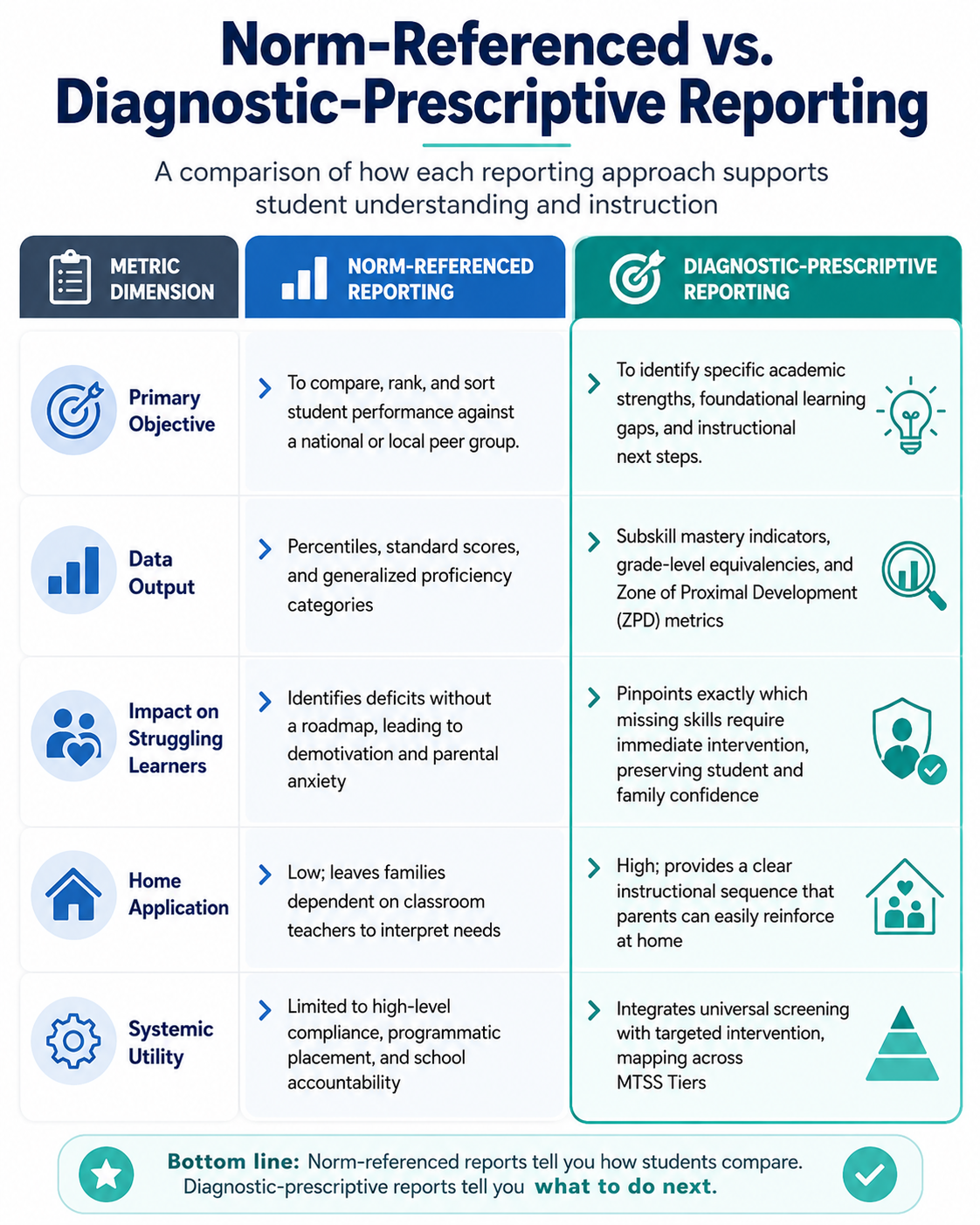
To establish a successful family engagement framework, districts must deploy dual-purpose assessments that function as robust diagnostic engines7. Standard computerized adaptive benchmark tests often restrict their testing range to the student’s current grade level, failing to identify foundational skill deficits from prior years7.
In contrast, specialized diagnostic assessments such as the Diagnostic Online Reading Assessment (DORA) and the Adaptive Diagnostic Assessment of Mathematics (ADAM) evaluate students across a comprehensive K-12 spectrum regardless of their enrolled grade8. This approach separates students’ performance from their age, tracing their actual skills to find the exact boundary of what they know17.
DORA systematically analyzes reading across seven distinct sub-tests: high-frequency words, phonetics, phonemic awareness, oral vocabulary, spelling, reading comprehension, and word recognition8. Rather than reporting a single aggregated reading score, DORA provides a clear breakdown of these subskills8.
For example, if a third-grade student struggles with reading, DORA isolates whether the bottleneck is driven by a decoding issue or a vocabulary deficit13. This allows parents to see that their child has mastered basic sight words but needs to work on a specific phonics principle, such as silent-e or diphthongs, giving them a clear and targeted point of focus for home practice6.
In mathematics, ADAM evaluates student learning across 44 distinct sub-tests spanning five core mathematical strands: numbers and operations, measurement, algebra, geometry, and data analysis8. When a middle school student faces difficulties with grade-level math, ADAM traces their performance back through the scope and sequence to locate missing prerequisite skills15.
If the student struggles with multiplication, ADAM can show that they lack foundational subtraction regrouping skills, allowing parents to understand the specific skill within the mathematical scope and sequence that requires attention6.
For secondary students, specialized diagnostics such as the Diagnostic Online Math Assessment (DOMA) target Pre-Algebra and Algebra readiness by examining specific subskills like integer operations, factoring polynomials, or radical expressions, ensuring that the school and family can target exact conceptual gaps8.
Online tools for special education
Accelerating Action via Real-Time Visual Systems and Automated Instruction
To turn academic assessment data into home-based action, districts must utilize tools that deliver results in real time and present them in a clear, parent-friendly manner9. Traditional assessment models often rely on summative assessments administered only three times a year, with manual data entry delaying reports by weeks or months9. This lag leaves both educators and families in the dark regarding a student’s immediate, evolving needs9.
To overcome this hurdle, school districts must implement digital assessment tools designed to process student responses instantly, making the data immediately available to educators, administrators, and parents9.
As outlined by the Measures for Early Success Initiative led by MDRC, effective parent communication requires that raw scores be translated into clear visual metaphors and directly linked to instructional next steps9. For example, early childhood platforms like I-SPEAK visually represent a child’s strengths as a developmental progression using plant-based metaphors9. In the Class View, students’ performance across multiple domains (such as math or social-emotional learning) is shown as plants developing from “yet to plant” to “emerging,” “growing,” and “flourishing”9. In the Individual View, the student is depicted as a flower with five petals representing separate developmental domains, where the length of each petal corresponds to their progress level9.
This visual representation demystifies the learning process and helps families understand exactly what their child has mastered, meeting the expressed needs of caregivers who want to see what their child missed, what questions they struggled with, and where they excelled9.
Furthermore, these diagnostic assessments must connect directly to targeted learning paths to ensure that families can easily support student progress at home7. For example, the Let’s Go Learn platform links diagnostic outputs from DORA and ADAM to the LGL Edge system, which automatically provides personalized reading and math lessons8. This closed-loop system reduces the cognitive load on parents by providing self-paced gamified instruction that incorporates animation, graphics, and music to keep students engaged at home7.
By providing families with easily accessible visual progress indicators, districts can transform the parent-school relationship into an active data-driven partnership8.
Systemic Implementation through the Dual Capacity-Building Framework
To build a sustainable district-wide family engagement initiative, administrators should align their strategies with the Dual Capacity-Building Framework for Family-School Partnerships developed by Dr. Karen Mapp1. This framework emphasizes that effective engagement requires building the capacity of both school staff and families to work together in trusting, respectful partnerships2.
Dr. Mapp compares relational trust to the “oil in a car,” pointing out that while districts frequently purchase expensive instructional programs or organize standard curriculum nights, these efforts fall flat without a foundation of mutual trust between home and school2. Many school districts struggle with engagement due to systemic challenges, such as a lack of system-level leadership, insufficient teacher training, or the common misconception that a family’s physical absence from school events indicates a lack of care2. To overcome these barriers, districts must move away from generic events and implement Mapp’s six process conditions to design learning-centered opportunities that share these qualities2:
- Relational: Focus on building mutual trust19. Districts should train teachers to make positive introductory phone calls and conduct home visits to build strong, respectful relationships before discussing academic data2.
- Linked to Learning: Connect all family initiatives to the district’s core teaching and learning goals19. Rather than hosting generic social events, schools should organize interactive learning nights centered on teaching families how to interpret diagnostic data and support specific reading or math skills at home2.
- Asset-Based: Value families for the unique insights and strengths they bring19. Teachers should view parents as vital “funds of knowledge,” inviting them to share perspectives on their children’s interests and learning habits to help customize classroom instruction2.
- Culturally Responsive: Respect and honor the diverse cultural backgrounds of all families19. This includes providing translated score reports, utilizing bilingual interpreters, and offering culturally relevant materials that reflect the community’s student demographics19.
- Collaborative: Create opportunities for shared learning between educators and families19. Instead of traditional, one-way parent-teacher conferences, schools should adopt collaborative formats where parents and teachers review diagnostic data together to co-create academic growth plans2.
- Interactive: Develop two-way communication channels that accommodate diverse family needs4. Schools can send home data folders that allow parents to easily write back with comments, or utilize two-way texting platforms to ensure continuous, accessible communication19.
Furthermore, districts can empower parents by teaching them to use tools from organizations like the Right Question Institute, which helps families learn to ask targeted questions during conferences, such as “Tell me more about how my child is doing in multi-digit subtraction,” rather than accepting a generic “fine”2.
To ensure consistency across all school sites, superintendents must hire dedicated district-level family engagement directors who can provide systemic training, clear policies, and resources to support school teams2.
Broadening the Scope: Holistic Life-Centered Engagement and Future Success
A truly comprehensive family engagement initiative must extend beyond core academic scores to support the development of the “whole child”10. By incorporating life skills and holistic transition planning, such as the Life Centered Education (LCE) 2.0 framework, school districts can help families prepare students for long-term independence, career readiness, and active community participation10:
- Collaborative Financial and Legal Planning: As students advance through secondary education, districts can engage families by providing resources on financial literacy, legal planning, and transitioning to adulthood30. This includes educating families on legal options like power of attorney or guardianship, and teaching students how to communicate with guardians about their financial goals and personal preferences30.

- Bridging the School-to-Career Transition: Districts can help families become active partners in career exploration by encouraging home-to-work connections, where parents describe their own jobs to help build career awareness30. Schools can also invite parents to help students build career portfolios that connect personal strengths, values, and academic growth directly to future employment requirements30.
- Health, Safety, and Digital Citizenship: Successful engagement initiatives help establish healthy routines that start at home and carry into the classroom10. Districts can provide frameworks to help families evaluate and improve physical and mental self-care routines, while offering shared resources on personal hygiene, emergency preparedness, and digital safety—including managing a digital footprint and identifying online scams10.
- Transition and Postsecondary Support Services: To help older students transition to life beyond high school, districts can offer training that supports parents in teaching students self-advocacy skills30. This ensures that families can help students express their own needs and preferences when accessing community resources, navigating academic accommodations, or applying for support services30.
To support this holistic approach, districts can leverage resources like Let’s Go Learn’s “How ready are you to learn today?” tool, which prompts students to share their emotional and mental state before starting lessons, giving teachers valuable insight into student well-being15.
Additionally, teachers can use a system of universal notes to document and share successful strategies—such as “student is highly motivated by music in math lessons”—across general education and special education departments, ensuring consistent, personalized support15.
System-Level Action Plan for District Administrators
To successfully transition family engagement from a traditional compliance-driven framework to an active, collaborative partnership, district leaders should implement the following system-level strategies2:
- Standardize on a Single Diagnostic Assessment Dataset: Transition away from fragmented benchmark testing and implement a unified, diagnostic-prescriptive assessment system across all general education, special education, and intervention departments7. Using a shared dataset allows all educators to speak the same language when communicating with families, establishing a consistent and reliable narrative that builds deep institutional trust2.
- Deploy Parent-Friendly Real-Time Dashboards: Ensure that families have immediate access to intuitive, jargon-free score reports that visually represent student progress, identify learning gaps, and explicitly define the student’s Zone of Proximal Development9. This gives parents a clear, accessible view of exactly what their child needs to work on next6.
- Offer Self-Paced, Automated Home Instructional Tools: Provide families with automated instructional programs, such as the LGL Edge platform, that automatically adjust to each student’s diagnostic gaps7. This allows parents to easily monitor a personalized home-based learning path without needing specialized training7.
- Establish Dedicated District-Level Family Engagement Leadership: Hire a designated family and community engagement director to coordinate strategies, provide professional development, and ensure consistent, high-quality family outreach across all schools in the district2.
- Conduct Formal Family Engagement Audits: Utilize validated assessment protocols, such as the Scholastic Family Engagement Assessment, to evaluate current outreach policies, measure institutional capacity, and implement targeted improvements to build stronger home-school partnerships5.
Learn more about summer school today!
Works Cited
- Karen Mapp’s Family Engagement Framework | Harvard Graduate School of Education, https://www.gse.harvard.edu/hgse100/story/improving-our-schools-one-family-time
- Family and School Partnership Building through the Lens of Dual-Capacity Framework by Dr. Karen L Mapp, https://schoolsignals.net/karen-mapp-family-school-partnerships/
- Partners in Education: A Dual Capacity-Building Framework for Family–School Partnerships, https://www.ed.gov/sites/ed/files/documents/family-community/partners-education.pdf
- Dual Capacity-Building Framework & Strategies – Waterford.org, https://www.waterford.org/blog/dual-capacity-building-framework/
- Family, School, & Community Engagement Programs & Resources | Scholastic Education, https://education.scholastic.com/education/solutions/family-school-community-engagement.html
- https://drive.google.com/open?id=16YyIoIozE1S2_gkecOeKIVK5PHPHViRZ
- https://drive.google.com/open?id=1MVlV8S24j3bxczTK6qkzlFaB85ATTU9U
- https://drive.google.com/open?id=1dhZBTPkM7YrnZOxcodaP0HgX9EXX90Dp
- Turning Assessment Data into Action: What Practitioners Need to Know – MDRC, https://www.mdrc.org/sites/default/files/Turning_Assessment_Data_into_Action.pdf
- https://drive.google.com/open?id=1r6hrMn58XTdfMo7YyVNXzEMmPKLRMwWC
- Norm-Referenced Testing | Social Sciences and Humanities | Research Starters – EBSCO, https://www.ebsco.com/research-starters/social-sciences-and-humanities/norm-referenced-testing
- Assessment Vocabulary for Teachers and Parents – The Craig School – Mountain Lakes, NJ, https://www.craigschool.org/loftin_letters/assessment-vocabulary-for-teachers-and-parents/
- https://drive.google.com/open?id=1PbwG3LVneSH-lKDb6E2KrXXXiVjs-6yH
- Understanding Tests: Norm-Referenced vs. Criterion-Referenced | Not Only Words Speech Therapy, https://nowspeechtherapy.com/understanding-tests-norm-referenced-vs-criterion-referenced/
- How to Create an Effective Individualized Education Program, https://www.letsgolearn.com/special-education/how-to-create-an-effective-individualized-education-program/
- Norm-Referenced vs. Criterion-Referenced Assessment – Classtime, https://www.classtime.com/en/norm-referenced-vs-criterion-referenced-assessment
- Homeschool Reading Placement & Assessment Online – Let’s Go Learn, https://www.letsgolearn.com/retail/homeschool-reading-placement-assessment/
- Communicating with Parents about Student Data – Renaissance’s Help Center, https://support.renaissance.com/s/article/Communicating-with-Parents-about-Student-Data-1752693978294
- How the Dual Capacity-Building Framework Can Help Teachers Increase Family Engagement with MAP Assessments – Teach. Learn. Grow. – NWEA, https://www.nwea.org/blog/2024/how-the-dual-capacity-building-framework-can-help-teachers-increase-family-engagement-with-map-assessments/
- Sharing Assessment Results with Parents – Illuminate Education, https://www.illuminateed.com/blog/2020/01/sharing-assessment-results-with-parents-families/
- Diagnostic Reading Assessments – Understand Student Reading Skills – Let’s Go Learn, https://www.letsgolearn.com/solutions/reading-assessments/
- Kindergarten Phonics Scope and Sequence, https://natalielynnkindergarten.com/kindergarten-phonics-scope-and-sequence/
- Let’s Go Learn | Diagnostic Assessments & Curriculum, https://www.letsgolearn.com/
- Scope & Sequence – Reading.com, https://www.reading.com/uploads/parent_scope_and_sequence.pdf
- https://drive.google.com/open?id=1uLB0OarPMA2iU6G6mxMgkS0C-aeFz_5P
- Dual Capacity Building Framework – Karen Mapp – MAEC – Mid-Atlantic Equity Consortium, https://maec.org/resource/dual-capacity-building-framework-karen-mapp/
- Dual Capacity Building Framework for Family-School Partnerships, https://www.ed.gov/sites/ed/files/documents/family-community/partnership-frameworks.pdf
- Chapter 6: Using Documentation and Assessment to Communicate with Families, https://minnstate.pressbooks.pub/cdev1610/chapter/chapter-6-using-documentation-and-assessment-to-communicate-with-families/
- Family Engagement – Attendance Works, https://www.attendanceworks.org/resources/toolkits/the-50-challenge-crafting-a-state-road-map/the-50-challenge-step-3/family-engagement/
- https://drive.google.com/open?id=1fhBJXcICSqwtSCT4jy70qdllUF2p_vGm
- https://drive.google.com/open?id=122lSFvXP7zMBhDHYevMUlyZyG2Lscptx
- Family, School & Community Engagement PD | Scholastic Education, https://education.scholastic.com/education/solutions/family-school-community-engagement/professional-development.html
- A Family Engagement Framework for All | Harvard Graduate School of Education, https://www.gse.harvard.edu/ideas/usable-knowledge/20/06/family-engagement-framework-all
