

The Core Deficit: How Math Gaps Actually Form
To solve the math crisis, we have to recognize the unique structural nature of mathematics. Math is not a collection of loosely related topics; it is a highly sequential, skill-based hierarchy. When a student misses a foundational concept in 3rd grade, such as unlike denominators in fractional or decimal place value, that missing skill acts like an unstable brick at the bottom of a tower.

North Carolina Senate Bill 1044, known as the Foundational Mathematics Act, establishes a rigorous framework to improve K–8 mathematics proficiency across the state by introducing a mandatory screening system. Modeled after North Carolina’s existing “Read to Achieve” literacy initiative, the legislation requires all public school units, including charter, regional, and lab schools, to administer formative and diagnostic math assessments to students in kindergarten through eighth grade at least three times per school year. The initial screening must occur within the first 30 days of the school year, with data delivered to teachers and parents within 15 calendar days. If a screener identifies a student as performing below grade-level proficiency, the school must develop an individualized Mathematics Success Plan (MSP) designed to pinpoint specific foundational skill gaps, establish benchmarks for growth, and provide targeted intervention services. Historically, North Carolina lacked a standardized framework for early math intervention comparable to its reading programs. SB 1044 was established to address a steady decline in middle school math proficiency by catching and fixing specific structural learning gaps early.
As students progress into 4th grade and up, the rigor of the curriculum intensifies exponentially. The standard pacing guide waits for no one. Teachers are forced to move forward to maintain alignment with state standards, leaving little to no time for deep remediation.
While most schools recognize this and build in generic review periods or “spiral review” warm-ups, these efforts are largely inefficient because the review necessary is not the same for any two students in a single classroom. One student is stumbling because they lack basic integer fluency; another is lost because they don’t understand spatial ratios. Pushing a whole class through a uniform review block fixes neither.
Let's Go Learn's diagnostic assessments
With Let’s Go Learn, you can create personalized instruction that inspires success for each learner, as you differentiate curriculum for intervention, remediation, and enrichment.
The Screening Fallacy: The Hidden Flaw in Scaled Scores
The Foundational Mathematics Act requires a “math screening assessment” three times a year. In response, many districts will naturally look to their large, established benchmark testing systems.
Here is the hidden flaw: the EdTech industry frequently misuses the word “diagnostic.” Most standard benchmark tests and screeners are fundamentally not instructional diagnostics.
Systems built on scaled scores or norm-referenced rankings can tell you that a student is performing at a low level, or that they are running two years behind their peers. What they cannot do is tell you precisely where the learning tower fractured. They provide a broad, macro-level summary of a student’s standing.
When a student is placed into a “low” tier on a single-score placement tool, weak-data personalization systems routinely drop them into a generalized, lower-track curriculum plan. This approach wastes critical instructional time by feeding the student a repetitive mixture of lessons that are too easy (revisiting concepts they already understand), too hard (demanding prerequisite skills they don’t possess), and only occasionally just right. This cyclic placement approach frustrates learners, burns out interventionists, and completely prevents the learning acceleration required to get a student back to grade level.
⚠️ Common Mistake for District Leaders
Assuming that a high-volume benchmark test or non-diagnostic screener provides the granular skill-level data needed to populate an actionable, compliant Mathematics Success Plan (MSP). Screeners group students; precision diagnostics place instruction.
The Special Education Standard: Unlocking Present Levels for All Learners
If non-diagnostic screeners cannot pinpoint the target gaps, what can? The answer lies in a framework that special educators have used for decades: finding a student’s true present level.
For a broad audience, it’s vital to define this clearly: Present level means the student’s actual current instructional mastery point, the level at which the student is really performing right now, completely independent of their chronological age or assigned grade level.
When we apply this rigorous, granular standard to general education interventions and MTSS tiers, the entire paradigm of math remediation shifts. Many struggling students are multiple years below grade level, meaning grade-level-only data is entirely insufficient for intervention planning. By uncovering the exact boundary line where a student’s mastery ends, educators can stop guessing and start targeting the precise skills a student lacks.
The Let’s Go Learn Difference: Precision Diagnostics Meet Targeted Instruction
This is precisely where Let’s Go Learn diverges from first-generation EdTech platforms. True personalization begins with true diagnostics, because diagnostic quality determines placement quality.
Let’s Go Learn’s ADAM (Adaptive Diagnostic Assessment of Mathematics) and DOMA (Diagnostic Online Math Assessment) were engineered from inception to serve as true precision diagnostics. Rather than dropping a struggling student into a broad remedial loop based on a single score, ADAM breaks mathematics down into 44 distinct constructs across K-8 concepts, testing down to the exact sub-skill level to determine where the structural breakdown occurred.
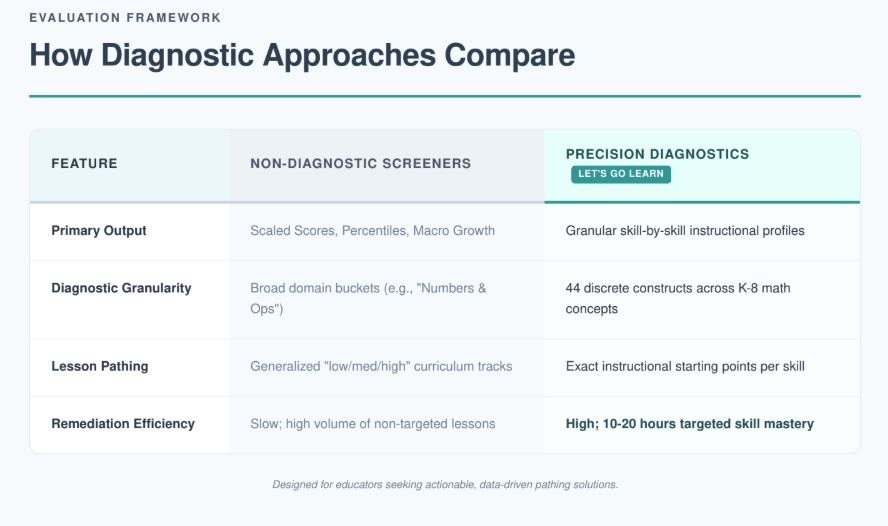
Finding the gap is only half the battle; the next step is execution. Because Let’s Go Learn captures true diagnostic data, it seamlessly unlocks LGL Math Edge, a specialized intervention system providing targeted, explicit, evidence-based instruction.
Because Math Edge is grounded in flawless present-level data, it dispenses with the fluff and targets only the specific skills needed to be taught. There are no wasted lessons. By tracking the exact instructional mastery point, Math Edge delivers specialized, adaptive instruction that allows the average non-proficient student in grades 3 to 8 to complete remediation in just 10 to 20 hours. This isn’t just slow remediation; it is genuine learning acceleration.
Practical Implications for North Carolina Districts
As the Foundational Mathematics Act progresses toward implementation, North Carolina district leaders must think strategically about the tools they adopt.
- Move Past Compliance Audits: Do not select a tool simply because it can fulfill the three-times-a-year math screening assessment requirement. Choose a platform that serves double duty as an immediate instructional roadmap.
- Examine Your MSP Data Pipeline: Ask your curriculum and instruction teams: Does our current assessment give a teacher the exact sub-skill missing, or does it just give them a macro score that requires them to do the heavy diagnostic lifting themselves?
- Protect Teacher Time: Teachers do not have the hours required to reverse-engineer weak data scores into individual success plans. Provide them with precision diagnostics that automatically generate clear, actionable, skill-level instructional tracks.
If we want true math acceleration across North Carolina, we must stop building intervention paths on weak data. True personalization demands true diagnostics.
Ready to align your district’s math strategy with the upcoming mandates of the Foundational Mathematics Act? Learn how Let’s Go Learn’s precision diagnostics and LGL Math Edge can instantly populate and execute highly effective Mathematics Success Plans for your K-8 students. Schedule a technical briefing with our team today.
