

The Back-to-School Roadmap: Unifying Screeners and Diagnostic Baselines for Educational Acceleration and Compliance
The beginning of a new school year presents a recurring challenge for district leaders: how to balance rapid, top-of-funnel risk screening with deep, actionable diagnostic evaluations.
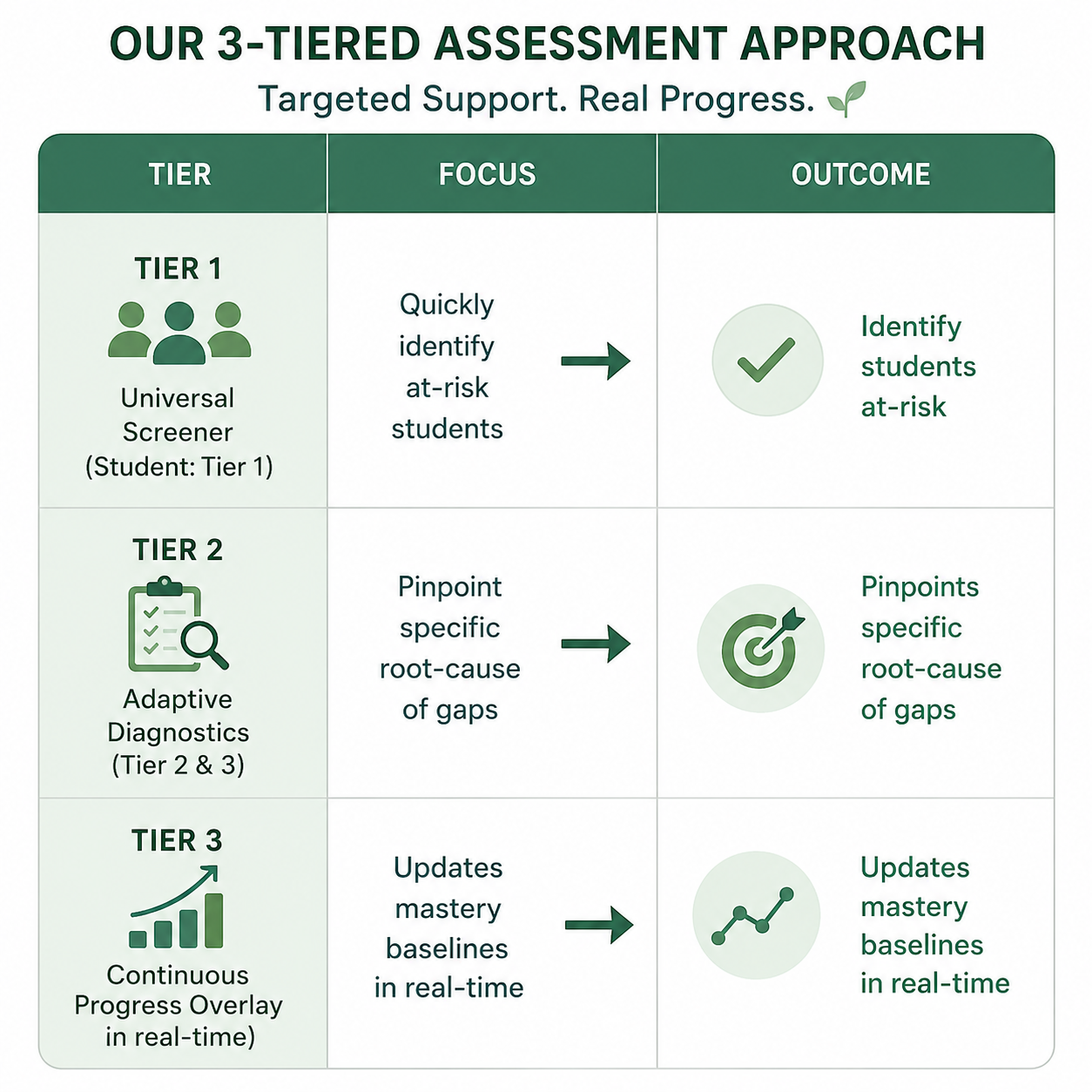
Historically, districts have relied on brief, timed screeners—such as one-minute oral reading fluency probes or sight-word lists—to flag students performing below grade level. While these universal screeners serve a critical role in quickly identifying at-risk students, they are blunt instruments. They answer the question “Who is struggling?” but fail to explain “Why are they struggling, and what should we teach tomorrow?”
When districts rely solely on screeners to drive instruction, struggling students often get trapped in a repetitive cycle of standard-aligned test preparation that fails to address root-cause deficits.
The False Choice: Universal Screeners vs. Granular Diagnostics

Some industry conversations suggest that districts should abandon universal screeners entirely in favor of deep diagnostic assessments. However, in practice, districts need both:
- Universal Screeners: Essential for fast, low-burden risk identification across 100% of the student population at Tier 1.
- Granular Diagnostics: Crucial for Tier 2/3 interventions, MTSS planning, and Special Education, where educators need subskill-level clarity to design targeted instruction.
Requiring every student to complete a multi-hour diagnostic assessment creates unnecessary testing fatigue for the 50–70% of students performing on grade level. Conversely, stopping at a screener leaves teachers without a clear roadmap for intervention.
The modern solution isn’t replacing screeners—it is adopting a single, streamlined assessment ecosystem that seamlessly transitions a flagged student from broad risk-identification to targeted diagnostic analysis.
Compliance Imperatives and Student Mobility
The need for precise baseline data is driven by both pedagogy and legal necessity. Under 34 CFR § 300.111 (the federal Child Find mandate), districts have an ongoing obligation to identify, locate, and evaluate all children with suspected disabilities.
When mobile students transfer into a district without immediate, detailed diagnostic baselines, instructional planning stalls—risking both legal non-compliance under IDEA and academic stagnation. State-level requirements have added further urgency:
- The Illinois School Code mandates annual universal screening for mental and social-emotional health across grades 3–12.
- The Georgia Early Literacy Act mandates universal reading screeners alongside unified literacy plans.
Unified diagnostic platforms like Let’s Go Learn address this by providing an adaptive starting point across K–12. Rather than summarizing performance into a single, vague scaled score, adaptive diagnostics evaluate isolated subskills across grade levels. For example, a diagnostic assessment can identify a first-grade phonics deficit in a tenth-grade student, pinpointing the exact link where the learning chain broke.
Let's Go Learn's diagnostic assessments
With Let’s Go Learn, you can create personalized instruction that inspires success for each learner, as you differentiate curriculum for intervention, remediation, and enrichment.
Targeted Diagnostics in Secondary Reading and Writing
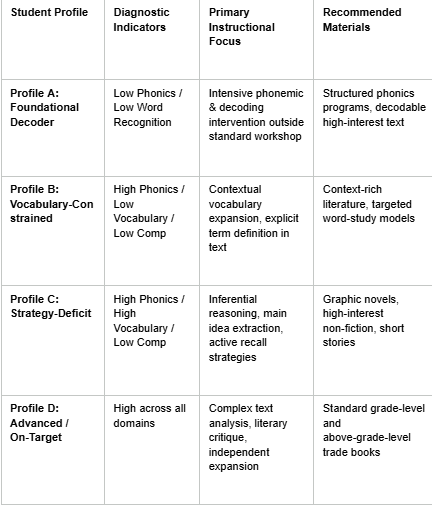
Literacy is not a monolithic skill—it is a system of interconnected cognitive subskills. Utilizing tools like the Diagnostic Online Reading Assessment (DORA) allows secondary educators to isolate vocabulary development from reading comprehension to identify the specific nature of a student’s struggle:
- Low Vocabulary + Low Comprehension: Require instructional materials with explicit, contextual explanations of terms embedded directly within the text (e.g., Lemony Snicket-style contextual narratives).
- High Vocabulary + Low Comprehension: Require materials written at the student’s independent reading level that feature explicit opportunities to practice factual recall and inferential reasoning (e.g., graphic novels or structured short stories).
Class Profile Grouping Matrix
To turn baseline data into daily instruction, teachers can group students based on shared DORA profiles:
Additionally, analyzing spelling baselines alongside writing workshops reveals that low spelling scores frequently correlate with an active resistance to using complex vocabulary. Catching this early enables teachers to provide supportive editing frameworks, encouraging students to express sophisticated ideas without fear of spelling penalties.
The Science of Math and Learning Acceleration
Mathematical development is strictly sequential. Broad remediation—stopping the curriculum to re-teach an entire prior grade’s textbook—often delays student progress and increases frustration.
Aligned with the Science of Math, adaptive diagnostic tools like the Adaptive Diagnostic Assessment of Mathematics (ADAM) and DOMA (Pre-Algebra / Algebra) evaluate students across 44 distinct sub-tests in five core strands:
- Numbers and Operations
- Measurement
- Algebra
- Geometry
- Data Analysis
This data enables Learning Acceleration: keeping students anchored in grade-level content while providing targeted “just-in-time” scaffolding for specific missing prerequisites.
High-Dosage Tutoring (HDT) Criteria
When baseline gaps require intensive intervention, districts can deploy High-Dosage Tutoring aligned with evidence-based criteria:
- Frequency: Minimum of 3 weekly sessions.
- Duration: 30 to 60 minutes per session.
- Ratio: Capped at a maximum of 4 students per tutor (4:1).
- Staffing: Consistent, trained tutors or certified paraprofessionals using baseline diagnostic data.
Anchoring AI Support in Verified Diagnostic Context
As Artificial Intelligence tools enter special education workflows, “hallucinations” and vague recommendations remain major concerns. AI models are only as good as the context they are fed.
Through context engineering, platforms like Let’s Go Learn connect AI tools directly to a student’s verified, de-identified diagnostic dataset.
Within spaces like the Teacher Empowerment Toolkit (TET)—a CEC-branded workspace featuring the Airma AI assistant—teachers can generate precise IEP drafts, tailored lesson plans, and SMART goals grounded in real diagnostic data. By automating documentation overhead, context-engineered AI can reduce IEP drafting times by up to 85%, freeing up critical hours for direct student instruction.
Learn more about summer school today!
Strategic Recommendations for District Leaders
- Unify the Assessment Ecosystem: Avoid forcing teachers to juggle disconnected screeners and diagnostic tools. Select a single, streamlined platform that handles Tier 1 screening and automatically routes flagged students into adaptive diagnostic sub-testing.
- Shift to Continuous Overlay Monitoring: Replace disruptive, periodic testing blocks with brief, ongoing skill quizzes that continuously update the student’s diagnostic baseline in real time.
- Equip Special Educators with Context-Engineered AI: Protect student privacy and reduce administrative burnout by providing AI tools connected directly to validated diagnostic profiles, enabling faster, compliant IEP drafting and deeper instructional personalization.
