

Equity in Special Education: Policy, Frameworks, and Fiscal Accountability
Theoretical Frameworks of Equity versus Equality in Educational Design
The division between educational equality and educational equity represents a fundamental tension in school reform and policy design. While these terms are frequently conflated, they constitute very different approaches to resource allocation, instructional delivery, and student outcomes. Educational equality is grounded in standard procedural neutrality, ensuring that all students receive identical resources, pacing guides, and standardized curricula regardless of their starting points. This standardized approach assumes a uniform student profile and relies heavily on fixed pacing and narrowly taught academic content. Educational equality can also mean equal access, equal protection, equal opportunity, consistent procedural safeguards, or equal entitlement to high-quality instruction. Those forms of equality are essential to special education. But in practice, this uniformity can act as a sorting mechanism that favors students from privileged backgrounds while widening opportunity gaps for those facing systemic, linguistic, or cognitive barriers.

In contrast, educational equity is a philosophical and operational framework rooted in social justice, fairness, and inclusion. It acknowledges that learner variability is a predictable aspect of human development and requires proportional, customized allocation of resources based on individual student needs. In an equitable system, policies and practices are designed to ensure that background characteristics—such as race, socioeconomic status, language, and disability status—do not predict student success. This distinction is critical in the design of student evaluations. Grade-level proficiency assessments alone are insufficient for determining the instructional starting point or conducting a comprehensive special-education evaluation. Traditional assessments focus on grade-level standards-based proficiency, only measuring a student’s performance against their current grade level. These standard measures often hide deep learning gaps and fail to identify a student’s actual learning potential. Equity in special education requires schools to identify disabilities accurately, provide individualized and appropriately ambitious instruction, examine outcomes for demographic disparities, and fund services in ways that support students without encouraging inappropriate identification.
An equitable approach, however, uses broader ranging, vertically aligned datasets across General Education, Intervention, and Special Education. This alignment allows teachers to work with a shared instructional vocabulary and target a student’s specific deficits within their Zone of Proximal Development (ZPD). By identifying foundational gaps regardless of the student’s current grade level—such as locating a first-grade reading deficit in a twelfth-grade student—equitable systems can provide targeted, personalized learning paths. For example, CEC recently announced the inclusion of Let’s Go Learn’s diagnostic assessments and supplemental curriculum as a free tool for all members, to help support best practices in finding and addressing individualized learning paths. This benefit is called the Teacher Empowerment Toolkit (TET). This individualized approach helps ensure that students receive the specific support required to access high-quality instruction and make meaningful progress. Equality establishes common rights, protections, and expectations. Equity recognizes that students may require different supports to benefit meaningfully from those rights and opportunities
Federal Civil Rights Protections and Significant Disproportionality
Under federal law, educational equity is monitored through statutory safeguards designed to protect historically marginalized groups from discriminatory educational practices. Codified under Section 618(d) of the Individuals with Disabilities Education Act (IDEA) Part B, states are legally mandated to collect and analyze annual data to identify and address “significant disproportionality” based on race and ethnicity. Significant disproportionality occurs when students of a specific racial or ethnic group are disproportionately identified for special education, placed in highly restrictive settings, or subjected to harsher disciplinary removals than their peers. This framework requires states to analyze outcomes across seven racial and ethnic groups and fourteen categories of analysis, using standard risk ratios to measure systemic disparities.
- Hispanic or Latino of any race
- American Indian or Alaska Native
- Asian
- Black or African American
- Native Hawaiian or Other Pacific Islander
- White
- Two or more races
Data compiled by the National Center for Learning Disabilities highlights persistent inequities across demographic groups. For example, in the 2020 NCLD report, Black students are 40 percent more likely to be identified with a disability overall and are disproportionately identified as having emotional disturbances or intellectual disabilities compared to other student groups. Similarly, American Indian and Alaska Native students are twice as likely to receive services for Specific Learning Disabilities (SLD). Once identified, students of color are more likely to be taught in separate, highly restrictive classrooms and are subjected to higher rates of suspension and expulsion. These disparities are influenced by a combination of systemic biases and a higher likelihood of Adverse Childhood Experiences (ACEs) among marginalized groups. These childhood traumas—including the death of a parent, parental incarceration, witnessing domestic or neighborhood violence, household mental illness, substance abuse, and racial discrimination—can lead to behavioral expressions that schools often misidentify as emotional or learning disabilities.
Crucially, studies show that when comparing only students from non-low-income backgrounds across races, Black and Hispanic students remain twice as likely to be identified for special education compared to White students. This demonstrates that systemic disparities are not merely a byproduct of socioeconomic status but are deeply linked to racial bias in assessments, academic policies, and school climates. Furthermore, charter school LEAs are particularly vulnerable to these reporting deficiencies and compliance oversight gaps.
The political and administrative battle over these reporting requirements has been a focus of ongoing federal policy debates. The U.S. Department of Education proposed eliminating requirements for states to report their significant disproportionality methodologies, citing “burden reduction.” This proposal was met with strong opposition from civil rights organizations, including the Center for American Progress (CAP). Opponents argue that removing these reporting requirements would weaken federal oversight, reduce transparency, and undermine civil rights protections for disabled students of color. These indicators are also essential for fiscal monitoring, ensuring that states do not misallocate federal IDEA funds that must be reserved for Coordinated Early Intervening Services (CEIS) to address overrepresentation.
Learn more about education reform
State Accountability and Programmatic Course Corrections: California and SFUSD
When states identify local educational agencies (LEAs) with significant disproportionality, they must implement federally mandated corrective actions. The California Department of Education (CDE) addresses these disparities through the Compliance and Improvement Monitoring (CIM) process. The CIM framework supports identified LEAs by providing structured technical assistance and monitoring across a four-stage process. LEAs must gather and review data on identification, placement, and discipline; investigate the systemic root causes of these disparities; plan a detailed corrective roadmap with specific timelines; and implement the plan while tracking progress.
Furthermore, under IDEA regulations, any LEA identified with significant disproportionality is required to reserve exactly 15 percent of its IDEA Part B (Sections 611 and 619) grant funds. These reserved funds must be used to develop and implement Comprehensive Coordinated Early Intervening Services (CCEIS). These services are designed for children from age three through grade twelve, with a focus on students in overidentified groups who require additional academic and behavioral support but are not currently identified as needing special education.

The implementation of these corrective actions is illustrated by the San Francisco Unified School District (SFUSD). The CDE sanctioned SFUSD due to a persistent overrepresentation of Black/African American children in special education relative to their population in the district. Consequently, SFUSD reallocated 15 percent of its special education budget to fund CCEIS initiatives within general education, aiming to dismantle the biased beliefs and structural practices that lead to over-identification.
Under the leadership of a dedicated CCEIS administrative team, SFUSD’s corrective roadmap includes several targeted initiatives. The district collaborates with community educational partners to address the needs of “Rising Scholars”—Black, Latinx, and Pacific Islander students who are disproportionately impacted by systemic inequities. A core component of SFUSD’s CCEIS strategy is the SFUSD Shoestrings Program, a community-designed, wraparound early childhood intervention program. Because preschoolers are suspended at higher rates than any other age group, and young Black boys are disproportionately affected by these disciplinary actions, Shoestrings intervenes early. By providing targeted social-emotional and behavioral supports in early childhood, the program works to reduce exclusionary discipline and inappropriate special education placements, addressing the root causes of the preschool-to-prison pipeline.
Core Systemic Instructional Frameworks: MTSS, UDL, and Specially Designed Instruction
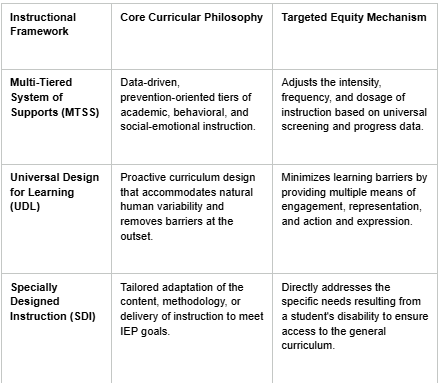
To translate judicial standards of equity into classroom practice, schools utilize three integrated instructional frameworks: Multi-Tiered System of Supports (MTSS), Universal Design for Learning (UDL), and Specially Designed Instruction (SDI). MTSS is an evidence-based, data-driven framework designed to address the academic, behavioral, and social-emotional needs of all students through a continuum of tiered interventions. Under the Every Student Succeeds Act (ESSA) of 2015, MTSS is defined as a systemic framework that supports a rapid response to student needs through regular observation and data-based decision-making. ESSA emphasizes the role of MTSS in increasing educators’ capacity to teach all learners effectively, including those with significant cognitive disabilities and English learners, so they can meet challenging state standards.
The practical application of MTSS is illustrated by state initiatives like the Kentucky Academic and Behavioral Response to Intervention (KY-ABRI) project. KY-ABRI supports schools by scaling up a three-tiered technical assistance model. Tier 1 provides all districts and schools with access to online tutorials and training. Tier 2 offers targeted online consultations with content and behavioral experts. Tier 3 provides intensive on-site coaching for specific districts with persistent student performance issues.
Within classrooms, teachers use a variety of instructional models to differentiate core instruction within the MTSS framework. Models such as station rotation, individualized playlists, and student-selected choice boards allow teachers to work with small groups, presenting core concepts with varying levels of complexity and scaffolding. These structures keep students cognitively engaged and support inclusive practices by keeping diverse learners in mainstream classrooms.
Automatic, personalized learning
Core classroom instruction is further enhanced when built upon the Universal Design for Learning (UDL) framework. Originally derived from universal design in architecture—which established that features like curb cuts benefit all individuals—UDL applies this philosophy to educational design. UDL operates on the premise that standard “one-size-fits-all” curricula create artificial barriers to learning. By recognizing learner variability, UDL proactively designs educational spaces, goals, materials, and assessments to support a wide range of learners without lowering expectations.
When a student requires support beyond these universal designs, Specially Designed Instruction (SDI) is provided. SDI goes beyond differentiated instruction and UDL by adapting the content, methodology, or delivery of instruction to address the unique needs of an eligible child under the IDEA. This adaptation is designed to ensure that the child can access the general curriculum and meet grade-level standards.
To deliver personalized instruction at scale, educational technology platforms can integrate UDL and diagnostic metrics. Adaptive digital learning systems, such as Let’s Go Learn (LGL), leverage diagnostic assessments to identify a student’s specific instructional point or zone of proximal development. These platforms provide real-time personalized instruction and scaffolding resources aligned with a student’s IEP or Section 504 goals. To reduce cognitive load and support engagement for non-traditional and at-risk learners, these digital tools present lessons through multiple modes, including animation, graphics, voice, and music, paired with diverse characters and culturally relevant themes. This approach optimizes learning and supports student motivation.
In specific domains like mathematics, this personalization is bolstered by explicit instruction. To support diverse student populations and address long-term demographic wage gaps, explicit math instruction uses a systematic hierarchy. Teachers explain and model mathematical concepts clearly before students engage in guided and independent practice, helping to bridge learning gaps.
Diagnostic Equity: Dynamic Assessment and Culturally Responsive Evaluations
Evaluating culturally and linguistically diverse (CLD) student populations requires diagnostic tools that can distinguish true developmental disorders from language differences or a lack of educational exposure. Traditional standardized assessments compare a child’s performance to monolingual mainstream norms. These static tests often measure students’ prior experiences and opportunities rather than their learning potential, placing CLD and low-income students at a disadvantage. This bias often leads to the over-identification of language impairments in students who speak English as an additional language or use a different dialect.
To address these limitations, professional organizations such as the American Speech-Language-Hearing Association (ASHA) recommend using Dynamic Assessment (DA) as a complementary evaluation tool. Based on Vygotsky’s social-constructivist model of cognitive development, Dynamic Assessment evaluates students’ learning processes and potential rather than their accumulated knowledge at a single point in time.
Dynamic Assessment employs an active “Test-Teach-Retest” (TtR) protocol. First, the evaluator administers a pre-test to establish a baseline of the student’s skills. Next, the evaluator conducts a Mediated Learning Experience (MLE), which represents the core teaching phase of the assessment. During the MLE, the evaluator interacts within the student’s Zone of Proximal Development, using scaffolding to teach a specific skill while verbalizing key cognitive strategies. Finally, the evaluator administers a post-test to evaluate how the student applies the newly taught skill.
Crucially, the diagnostic focus is not on the change in scores but on the student’s modifiability. Modifiability is evaluated across three primary areas: student responsivity (the student’s engagement, focus, and response to instruction), transfer (ability to apply the skill to a different task), and examiner effort (the amount and intensity of support the evaluator had to provide).
A child who demonstrates low pre-test performance but exhibits high modifiability during teaching—meaning they learn, retain, and transfer the skill with minimal examiner effort—is likely presenting a language difference or a lack of exposure. Conversely, a child who continues to struggle despite intensive examiner effort and scaffolding shows low modifiability, which may indicate a true learning impairment.
While Dynamic Assessment requires more time than administering a standardized test, research demonstrates that it provides outstanding classification accuracy for culturally and linguistically diverse populations. Using narratives or storytelling tasks within DA is especially effective because stories are cross-cultural, providing a familiar context for children of all backgrounds.
Navigating Fiscal Mandates: California’s Story
The implementation of equitable policies in special education is dependent on the funding mechanisms that support local education agencies. Historically, special education finance systems have struggled to balance two competing policy goals: providing adequate funding to cover the high costs of specialized services while avoiding financial incentives that encourage districts to over-identify students for special education.
California’s primary program for financing special education services, enacted in 1997 through Assembly Bill (AB) 602, illustrates this policy challenge. AB 602 allocates the bulk of state special education funds using a census-based model. Under this formula, funding is distributed to Special Education Local Plan Areas (SELPAs) based on the total Average Daily Attendance (ADA) of all enrolled K-12 students in the region, regardless of the actual number of students identified with disabilities or the specific services they require. The policy rationale for a census-based approach is that it removes financial incentives for districts to over-identify students to secure additional state funding. It also grants local administrators the flexibility to design preventive services without fearing a loss of funding if their special education enrollment declines.
However, the AB 602 model has several structural limitations that impact educational equity. First, when the system was established in 1998, each SELPA’s funding rate was based on its historical special education spending under the previous unit-based J-50 system. This historical baseline locked in significant funding inequities across the state. Although the state made initial efforts to equalize these rates in the late 1990s and early 2000s, state-level equalization funding ceased after fiscal year 2000–01, leaving persistent funding disparities. For example, studies by state task forces highlighted that some SELPAs received nearly $230 more per pupil than neighboring areas with similar student demographics and identification rates, leading to substantial funding disparities per special education student.
Another challenge was that AB 602 funds were distributed to SELPAs using an aggregate calculation based on the Average Daily Attendance of their member districts. When a SELPA contained a mix of growing and declining districts, enrollment declines in some districts offset growth in others. This structural calculation penalized the SELPA as a whole and prevented growing districts from receiving growth funding unless funding for other member districts was reduced. The resulting shortfall forced districts to redirect local general fund dollars or AB 602 funds to cover basic special education costs, leaving fewer resources available for other students.
Fortunately, California worked hard to address these challenges. By early 2026, the Legislative Analyst reported that all but one SELPA had received the same per-student base rate, with further equalization under consideration for the 2026–27 fiscal year.
To support specific high-cost populations, the state provides additional resources, such as State Low-Incidence Funding (California Education Code Section 56026.5). These funds are part of the state’s principal apportionment and are allocated
To align special education with broader school finance reforms, the 2014-2015 Statewide Special Education Task Force (Mary Samples, Chair) recommended direct district funding, per-pupil equalization, and collaborative risk-pooling. This alignment is critical because of the fiscal friction that occurs when districts must use local general fund contributions to cover the gap between actual special education costs and state/federal allocations.
This tension is illustrated by the Los Angeles Unified School District (LAUSD) 2014-15 LCAP controversy. LAUSD attempted to include $450 million in existing special education expenditures as part of its baseline calculation for supplemental and concentration funds under the Local Control Funding Formula (LCFF). This maneuver reduced the amount of new state funds the district was required to spend on services for high-need unduplicated pupils (low-income, foster youth, and English learners) by approximately $126 million. This led to a formal challenge and a lawsuit by the ACLU and parent advocacy groups, who argued that using categorical special education expenditures to satisfy general equity allocations violated state funding laws. This case highlights the legal and fiscal tension of funding special education through general education funds.
Online tools for special education
Professional Standards and Collaborative Implementation: High-Leverage Practices
Ensuring educational equity across classrooms requires establishing a unified set of professional standards for educators. To support this need, the Council for Exceptional Children (CEC) and the CEEDAR Center developed High-Leverage Practices (HLPs) in special education. These practices are designed as research-based, fundamental instructional and collaborative strategies that occur with high frequency in teaching and are broadly applicable across grade levels and content areas. Co-authored by former practitioners with at least five years of classroom experience, HLPs translate complex educational research into practical tools.
The integration of HLPs provides a shared instructional language across schools and districts. This shared language is critical for addressing administrative gaps, such as the average six-month delay in fully implementing a student’s IEP when they transition between states. The twenty-two updated HLPs are divided into four core domains: Collaboration, Assessment, Social/Emotional/Behavioral, and Instruction.
The first three HLPs focus on the Collaboration domain. These practices require educators to work with other professionals to increase student success (HLP 1), organize and facilitate effective meetings with families (HLP 2), and collaborate directly with families to support student learning and secure needed services (HLP 3).
Because family collaboration represents a key aspect of student support, school leaders are encouraged to provide professional development that helps teachers engage with families from diverse backgrounds. This includes evaluating teachers’ comfort with culturally diverse families, offering opportunities to observe effective communication models, and supplying resources to foster accessible communication across digital and school-wide platforms.
The Assessment domain (HLPs 4-6) requires educators to use multiple sources of information to build a comprehensive understanding of a student’s strengths and needs, and to use progress data to guide adjustments to instruction. The Social/Emotional/Behavioral domain (HLPs 7-10) focuses on establishing consistent, respectful learning environments, conducting FBAs, and teaching positive social behaviors.
Finally, the Instruction domain (HLPs 11-22) includes systematically designing instruction toward specific goals (HLP 12), adapting curriculum tasks and materials (HLP 13), using explicit instruction (HLP 16), and providing intensive instruction (HLP 20). By implementing these practices with fidelity, educators can design instructional environments that support the academic progress and social-emotional growth of every learner.
