

Signs Your Child Is Falling Behind (and the Fastest Way to Help Them Get Ahead!)
Top 3 Key Takeaways
- K–12 assessment types serve different purposes—screeners, benchmarks, diagnostics, and formative assessments all play unique roles in the Assessment–Instruction (A–I) cycle.
- Only a true diagnostic assessment can identify why a student is struggling, making it essential for targeted intervention, especially for special education.
- Effective instruction depends on accurate data, whether delivered through core curriculum, supplemental programs, or differentiated online learning.
Many families and educators feel overwhelmed by the wide range of assessments used in K–12 education and how they influence what teachers do next. Gaining clarity on these tools helps everyone spot learning gaps sooner, act faster, and ensure that students get the help they need to succeed.

Math Diagnostic Assessments
Powerful diagnostics from foundational math through algebra.
The Assessment–Instruction Cycle (A–I Model)
At the heart of every effective classroom is a simple loop:
Assess → Instruct → Reassess → Adjust Instruction
This cycle helps teachers answer three essential questions:
- Did the student learn what I taught?
- If not, why not?
- What should I teach next?
This loop can be formal (standardized testing) or informal (quick checks for understanding), but it always works toward the same goal: helping students meet end-of-year grade-level standards.
The Types of K-12 Assessments Explained
1. Universal Screeners
Screeners are quick (10-15 minutes) checks used to determine whether a student is roughly on grade level or at risk. They do not diagnose what the problem is—only whether a deeper look is needed.
Outside resource:
- What is a universal screener? (MTSS Center): https://mtss4success.org
Recommended LGL Tool:
- Let’s Go Learn’s DORA & DOMA screeners: https://www.letsgolearn.com
2. State Accountability Tests
These are your state’s end-of-year tests (e.g., SBAC, STAAR, and MAP). They measure mastery of grade-level standards only—not below or above-grade skills.
They place students into broad categories such as proficient, approaching, or not proficient.
3. Grade-Level Benchmark Assessments
Benchmarks are given by districts multiple times per year (BOY, MOY, EOY). They show:
- Whether students are “on track”
- Whether they’re progressing as expected
- Whether learning loss is occurring
These tests still only measure grade-level skills.
4. Limited Diagnostics
A limited diagnostic tries to determine why a student is struggling—but only within a narrow range.
They work well if students are near grade level, but they fall short for:
- Students multiple years behind
- Students with IEPs
- Students in special education
Most commercial “diagnostic” tests fall into this category.
5. Genuine Diagnostics (The Gold Standard)
A true diagnostic reveals:
- Exactly why a student is struggling
- What to teach next
- How far below or above grade level they really are
This is essential for special education, MTSS, and individualized instruction.
- Let’s Go Learn’s skill-level diagnostics (DORA, DOMA, ADAM, ADAM2) provide true granular data: https://www.letsgolearn.com
6. Formative Assessments
These are quick checks—usually quizzes—given right after teaching a skill.
Examples:
- Did the child learn two-digit multiplication?
- Can they identify beginning sounds?
These assessments provide immediate feedback so teachers can reteach right away.
How Assessments Drive Instruction
Once assessments identify student needs, teachers select the right instructional tools. These fall into three categories:
Core Instruction
The grade-level curriculum (ELA, math, science, social studies).
Supplemental Instruction
Programs that support the core.
These can be:
- Group-based
- 1:1 individualized
Online Instruction
Three models exist:
- Linear online instruction
Students are placed on a set path regardless of actual skill gaps.
- Differentiated online instruction
Instruction adjusts automatically based on diagnostic data.
This requires a true diagnostic. - Teacher-directed online instruction
Teachers manually assign lessons based on student needs.
LGL recommendation:
Let’s Go Learn’s individualized online lessons are powered by true diagnostics:
https://www.letsgolearn.com
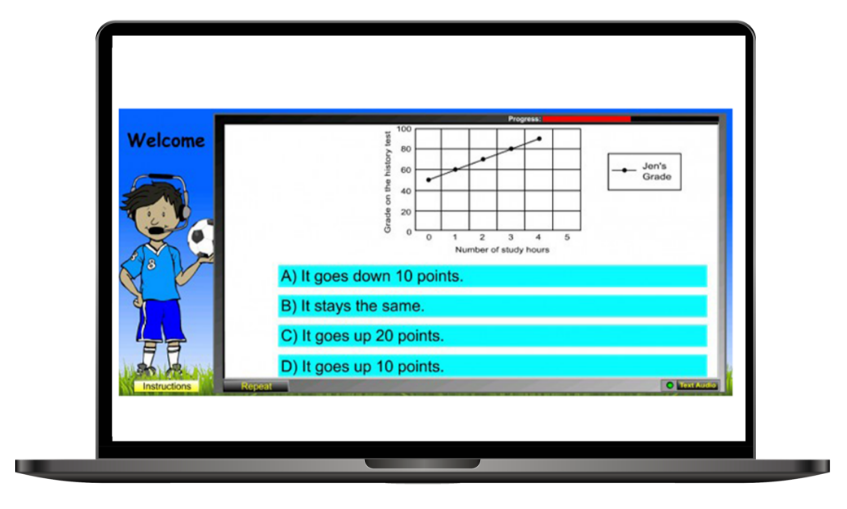
Let's Go Learn's diagnostic assessments
With Let’s Go Learn, you can create personalized instruction that inspires success for each learner, as you differentiate curriculum for intervention, remediation, and enrichment.
How to Know if Your Child Is Falling Behind
Here are common warning signs parents notice:
- Homework takes far longer than it should
- They avoid subjects like reading or math
- Grades stay low despite effort
- Benchmark or state test reports show “approaching” or “not proficient”
- Teachers mention “gaps,” “unfinished learning,” or “skill deficits”
The fastest way to know why a child is struggling is to use a genuine diagnostic assessment
The Fastest Way to Get Your Child Ahead
Step 1: Identify the gaps with a true diagnostic
Try Let’s Go Learn’s DORA (reading) or DOMA/ADAM (math):
https://www.letsgolearn.com
Step 2: Get a personalized learning plan
LGL provides skill-level data (phonics, comprehension, number sense, fractions, etc.).
Step 3: Begin targeted lessons immediately
LGL’s personalized online instruction adapts to each child’s exact needs.
This combination—diagnostic + individualized lessons—is the most efficient way to accelerate learning.
Final Thoughts
The world of assessments can be confusing, but understanding the differences helps families advocate for better support and ensures that students get targeted, personalized instruction. Whether your child is struggling, advanced, or somewhere in between, the right diagnostic data is the key to unlocking their potential.
