

Resolving the Dyslexia Screening Dilemma: Moving from Rapid Identification to Precision Reading Remediation in District MTSS
The Universal Mandate and the Screening Confusion
Universal literacy remains one of the most critical challenges in K to 12 education, with national data indicating that approximately 65 percent of fourth-grade students perform below the proficient level in reading. In response, state education departments across the nation have enacted strict mandates requiring universal early literacy and dyslexia screening in the early grades, often spanning kindergarten through third grade. For instance, Michigan’s Public Acts 146 and 147 of 2024 mandate universal screening by the 2027- 2028 school year. Colorado’s Senate Bill 25, 200, similarly requires local education providers to implement universal dyslexia screening within the same timeframe. While these policy changes represent a significant step toward early identification, they also introduce a critical operational challenge for district leaders. Many school systems struggle to differentiate between a brief screener, which simply flags potential risk, and a comprehensive reading diagnostic assessment, which pinpoints specific skill deficits.
To build an effective Multi-Tiered System of Supports (MTSS), school administrators must understand that screening is merely the first step. True learning acceleration requires identifying a student’s precise present level. Present level refers to a student’s actual current instructional mastery point, representing the specific level at which a student is performing right now, rather than the grade level in which they are enrolled. Many traditional assessments compress student performance into a single scaled score or a broad norm-referenced benchmark. For a classroom teacher or an interventionist, a single score is practically useless for instructional placement. It fails to isolate the specific cognitive or phonological breakdown occurring in the student’s reading development.
The Anatomy of a Screener: Why Identification Does Not Equal Diagnosis
A common misconception in the education technology market is that a digital early literacy tool can diagnose dyslexia. In reality, dyslexia is a neurobiological learning difference that primarily affects accurate word recognition, spelling, and decoding. It exists on a broad continuum and is independent of overall intelligence or motivation. Because of its neurological origin, a formal diagnosis of dyslexia can only be made by a qualified clinical specialist, such as a school psychologist, speech-language pathologist, or specialized clinical teacher, through a live and comprehensive evaluation.
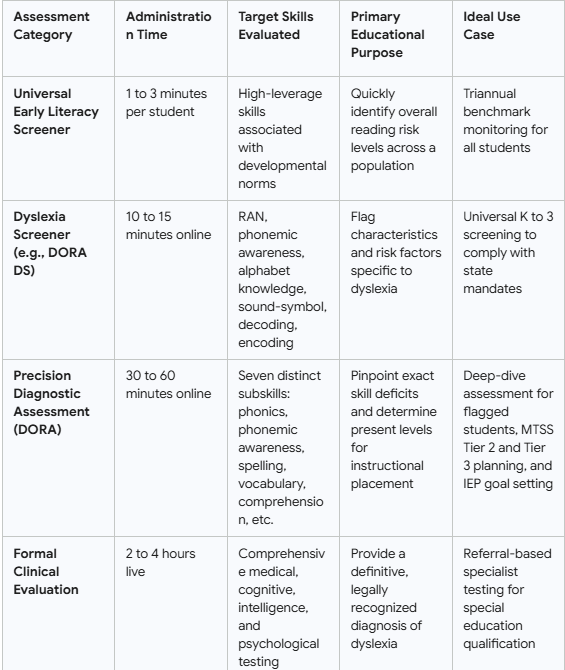
Consequently, any digital or paper-based test administered in a classroom setting is technically an early literacy or dyslexia screener, not a diagnostic engine. These screeners are designed to be brief, taking only 10 to 15 minutes to administer to an entire class. They function as a rapid triage mechanism, casting a wide net to catch any student who exhibits markers associated with reading difficulties. The primary objective of a screener is to determine whether further investigation or targeted intervention is necessary, providing a preliminary risk determination rather than a definitive label.
The International Dyslexia Association (IDA) recommends that early childhood screeners evaluate specific predictive skills such as phonological and phonemic awareness, letter-sound knowledge, and rapid automatized naming (RAN). The RAN subtest is especially critical, as it measures the speed at which a student can orally name a series of familiar items, digits, or letters, which serves as a key predictor of reading fluency and language processing speed. Research demonstrates that identifying reading difficulties in first or second grade is twice as effective as waiting until third grade or later, making early screening a vital tool for proactive intervention.
Let's Go Learn's diagnostic assessments
With Let’s Go Learn, you can create personalized instruction that inspires success for each learner, as you differentiate curriculum for intervention, remediation, and enrichment.
The False Positive Trap and the Strain on District MTSS Frameworks
Because universal screeners prioritize sensitivity to ensure that no struggling student is missed, they inherently possess a high margin of error that results in significant over-identification. A universal screener will flag a diverse cohort of students as at-risk. This cohort includes not only students with actual characteristics of dyslexia, but also English Language Learners (ELLs) navigating language acquisition, students with speech or attention delays, and those who have experienced instructional gaps or developmental delays. For example, a student learning English may struggle with phonemic awareness tasks simply due to a lack of exposure to English phonemes, rather than a neurobiological deficit.
When districts treat a one-time screener as a definitive gatekeeper for intensive special education services, it places an unsustainable strain on district resources and special education budgets. Staffing bottlenecks occur when special education teams are overwhelmed by referrals for students who do not actually have dyslexia, but instead simply require general reading remediation. Furthermore, false positives can generate unnecessary emotional distress for families who misunderstand the distinction between a preliminary screening risk flag and a formal clinical diagnosis. To mitigate this strain, school systems must implement a multitiered approach that filters flagged students through deeper diagnostics and monitored interventions before initiating formal evaluations.
The following table outlines the distinct operational and instructional characteristics of various assessment types within a district’s literacy framework:
Moving Beyond the Risk Flag: The Reading Specialist Territory
Once a student is identified as at-risk by a universal screener, the immediate challenge is determining the precise nature of the student’s struggle. The vast majority of students caught in the screening net do not require intensive, specialized special education services for dyslexia; instead, they require systematic reading remediation. This is the domain of the reading specialist and the general education MTSS framework. To move these students forward, educators must transition from a screening protocol to a detailed diagnostic evaluation.
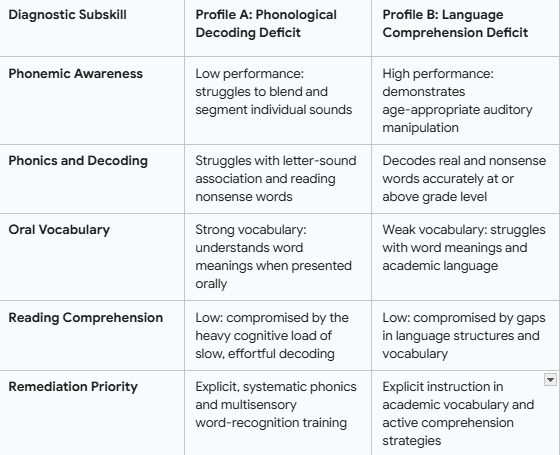
A structured reading diagnostic assessment investigates the multiple cognitive threads that contribute to overall reading comprehension. According to Scarborough’s Reading Rope and the Science of Reading, reading comprehension is the product of word recognition and language comprehension. When a student struggles, the teacher must know exactly which subskills are compromised. For instance, a child may have a strong oral vocabulary and excellent listening comprehension but perform poorly on a screener due to weak phonics and decoding skills. Conversely, another student might decode words with high accuracy but fail to understand the passage due to limited academic vocabulary. By separating these variables, a diagnostic assessment prevents the misapplication of intervention resources, ensuring that decoding remediation is not forced upon a student who actually requires vocabulary development.
The following table illustrates typical student profiles generated by a detailed diagnostic assessment, allowing educators to customize their reading remediation strategies:
The Let’s Go Learn Solution: Integrating DORA DS and DORA Diagnostics
True personalization begins with true diagnostics, and diagnostic quality determines placement quality. Let’s Go Learn provides school districts with an integrated assessment ecosystem that bridges the gap between mandatory compliance screening and precise classroom intervention. This approach is engineered around two core components: the Diagnostic Online Reading Assessment Dyslexia Screener (DORA DS) and the full Diagnostic Online Reading Assessment (DORA).
The first phase utilizes DORA DS as a universal, 10 to 15-minute online screening tool for kindergarten through third-grade students. Aligned with the Science of Reading, DORA DS screens for key indicators recommended by state departments and the IDA, evaluating phonemic awareness, alphabet knowledge, sound-symbol recognition, decoding, encoding, and rapid automatic naming. To eliminate false low scores, the screener includes a built-in mouse dexterity test. This feature identifies young learners who struggle with the computer interface rather than the linguistic content, protecting the validity of the data.
The second phase represents the critical departure from traditional assessment workflows. Instead of requiring teachers to administer a separate, paper-and-pencil diagnostic to students who fail the screening, the Let’s Go Learn system allows educators to immediately assign the full DORA assessment. DORA is an adaptive, K to 12 diagnostic assessment that is not capped by the student’s enrolled grade level. DORA breaks reading down into seven distinct, teachable subtests, including high-frequency words, word recognition, phonics, phonemic awareness, vocabulary, spelling, and silent reading comprehension.
This granular, skill-level data provides the precise present levels necessary to construct compliant, effective Individualized Education Programs (IEPs) for special education and targeted, multi-tiered intervention paths for MTSS. The diagnostic data also integrates with LGL ELA Edge, automatically generating personalized instruction paths that match the student’s exact Zone of Proximal Development. Furthermore, teachers can use this subtest data to effortlessly create homogeneous, skill-based small groups within the classroom, maximizing the impact of teacher-led instruction.
Online tools for special education
Next Steps for District Leaders
To establish an instructionally sound reading intervention program, district leaders should adopt several clear protocols:
- Establish a Two-Tiered Assessment Flow: Implement a rapid, validated screener like DORA DS for universal compliance, and immediately route any student flagged as at-risk to a comprehensive K to 12 adaptive diagnostic like DORA. This prevents premature, costly referrals to special education and ensures that students receive immediate, precise support.
- Decouple Screener Flags from Immediate Special Education Referrals: Educate school administrators and families that a positive screening result is not a diagnosis of dyslexia, but rather an indicator of general reading risk that requires closer diagnostic examination and tiered intervention.
- Replace Single-Score Benchmark Tests with Multidimensional Diagnostics: Transition away from testing systems that summarize reading ability into a single, consolidated score. Ensure that educators have access to granular, subtest-level data to understand the specific cognitive roadblocks of struggling readers.
- Empower Educators with Targeted Professional Development: Train reading specialists, special educators, and classroom teachers to translate diagnostic subtest data into structured, explicit instruction and effective small-group classroom configurations.
By shifting the district focus from basic screening compliance to precision diagnostics, school systems can optimize their intervention resources, accelerate student reading growth, and ensure that every child receives the exact instruction needed to achieve lasting literacy.
Ready to transform your district’s literacy screening into a high-impact intervention pathway? Contact the Let’s Go Learn team today to discover how combining DORA DS and the full DORA diagnostic can streamline your MTSS workflows and accelerate reading growth across your schools.
