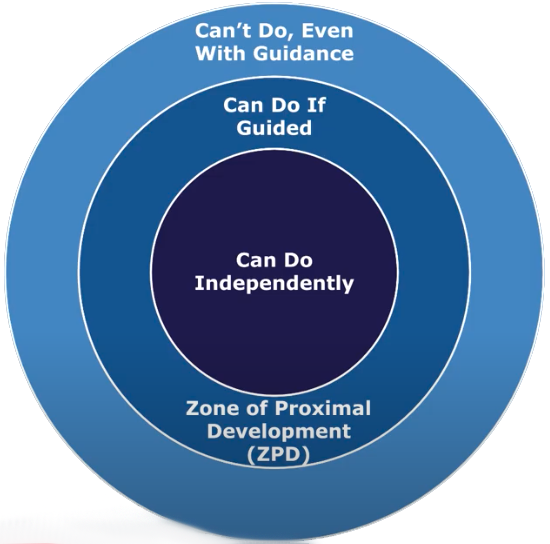

There are many kinds of assessment used in education to evaluate student learning, identify strengths and challenges, and aid in lesson planning, and they often take the form of online tools. Three common types of assessment, diagnostic, formative, and summative, are frequently used with K12 students to allow teachers and other educators to make decisions about placement, advancement, curriculum decisions, grades, and funding. Diagnostic assessments help educators develop a zone of proximal development (ZPD), by understanding why a student is struggling or excelling in a particular skill. Formative assessments give educators a snapshot of a students’s progress at a given time, and summative assessments help educators see where how a student is performing relative to other students at a point in time. The goal of all assessment is to improve student learning. Assessments allow educators to personalize instruction by adapting a curriculum to the ZPD of the individual student.
On this page, Let’s Go Learn and its partners provide a library of blog articles to introduce and explain educational assessments to everyone from professional educators and teachers, to tutors and homeschool parents. We welcome your comments.

How the Misuse of Assessments Can Hinder Student Achievement
Having worked in test development for over two decades, I’ve seen educational testing dramatically evolve over the years. This evolution has occurred not only in the use of technology to assess students, but also in people’s understanding of what testing is all about. I am happy to say that this understanding of testing by